
Mastering Essay Exams: Strategies for Success
E N D
Presentation Transcript
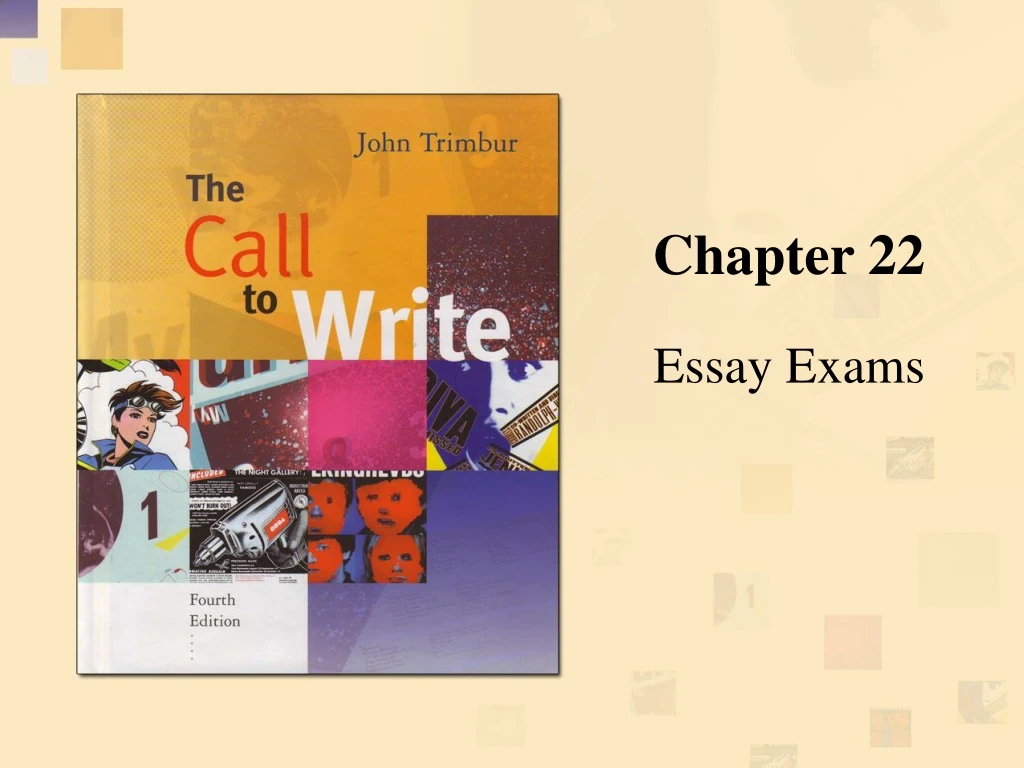
Chapter 22 Essay Exams
Test anxiety • Many people get nervous just thinking about taking an essay exam. • However, essay exams are a part of college life! • Let’s look at how to be successful.
Chapter overview • Preparing for essay exams • Analyzing the format and questions on the exam • Planning an answer • Writing the essay exam • How to prepare for an exam • Different kinds of essay test formats • Using the rule of three, outlines and maps • Typical types of exam questions
How are essay tests different? • Most tests focus on whether you have learned specific facts, terms, or formulas. • Essay tests require you to demonstrate your understanding of applying concepts by writing anywhere from several sentences to a page or more.
Objective vs. subjective • Test question formats such as true/false, multiple choice, and matching are examples of objective questions. There is a correct answer. • Essay test questions often include both an objective and subjective aspect, if you are asked your opinion.
Preparing for essay exams • Ask about format and scope (how many chapters will be covered). • Read over your notes, and review chapter summaries in your text. • Write sample questions and plan answers.
Overall approach for preparation • Don’t try to memorize big chunks of information. • Focus instead on the big picture; “the main ideas, terminology, controversies, explanations, and conceptual frameworks”. • Consider working with a study group.
Types of essay test formats What are the three different types of essay tests? • Identification items • Short answer • Long answer
Identification items • Short statements used to define a term or identify a researcher • Typical for introductory courses • Write one to two sentences, as needed.
Short-answer questions • Instructions may say to answer in a few sentences to several paragraphs. • It’s safest to develop a short thesis statement and write an organized mini-essay of several paragraphs.
Long-answer essay questions • Use more complex questions that require a more complex answer • Explore bigger concepts • A clue may be a question at the top of the page, and then rest of the page is blank!
Use time wisely • Identification items should be given the least amount of time. • Short-answer questions should be given a few more minutes, but probably no more than 10 minutes. • Essay questions, or long answer questions, may take from 20 minutes to an hour to complete.
Planning is essential • Take a few moments to think about the question; note key words. • Jot down a scratch outline of ideas to discover a three-part thesis statement. • Use a simple outline to organize ideas. • Add details, examples.
Example of an informal outline • Introduction (simple thesis with three points) • Body: first point and examples • Body: second point and examples • Body: third point and examples • Conclusion
The thesis • The main idea of your essay • Gives your reader a sense of organization • Builds in a mini-outline to essay • Three works well: for example, three reasons, three ways, three arguments, three views.
Drafting your answer • Realize you can only write a good rough draft; there is no time to do a major revision. • First impressions count. • Use the ideas in the question itself to frame the opening statement. • Provide supporting evidence, and tie in ideas from the course.
Drafting your answer, cont. • Write an ending, even if short on time. • Write legibly, and proofread. • Watch the clock. • If you feel you cannot finish, at least list the ideas from your outline to show where you are going. • See the student samples, pages 663-666.
Student Companion Website • Go to the student side of the Web site for exercises, chapter overviews, and links to writing resources for this chapter: http://college.hmco.com/pic/trimbur4e