Download
1 / 12
120 likes | 260 Vues
Understanding how to read scientific papers is crucial for researchers in computational fields. This guide outlines an effective order of reading, emphasizing key sections: Title, Abstract, Introduction, and Conclusion. It highlights critical thinking questions such as the clarity of methodologies, significance of results, and potential biases. By knowing what to look for, readers can evaluate the credibility of studies, assess whether the paper's findings support its claims, and consider whether all relevant issues have been addressed. This approach enhances comprehension and aids in informed discussions.

E N D
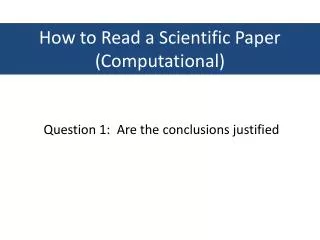
How to Read a Scientific Paper (Computational) Question 1: Are the conclusions justified
Order of Reading Operations Title – should give a clear indication of the content Abstract – presents a synopsis of the paper. Why was the work undertaken? How was it performed? What was determined? Conclusions – similar to abstract but may be more speculative Presents the “take-home message” for the paper The rest of the paper
Order of Reading Operations Introduction – Presents the background, the motivation and the current level of knowledge Results – what was determined? Discussion – significance and interpretation of the results Experimental/Methods – Details of the approach Should be sufficiently detailed that someone with experience in the method could reproduce the work
What to be Thinking Title and Introduction: What types of problems will likely have to be addressed in the paper? Is the Journal appropriate for the work? Is it reputable? Abstract and Conclusions: What results support their claims? Have they overstated the significance? Methods: Is it clear? Do you understand/trust the methods Results/Discussion: Have the calculations been validated? If so, how? Is the validation appropriate? Are the simulations converged? How was water treated? Have they discussed all of the relevant issues or are they ignoring something important?