Download
1 / 13
130 likes | 242 Vues
This lesson focuses on two key concepts: adding and subtracting integers, and the principles of inductive reasoning. Students will learn how to determine differences, write rules for number patterns, and test conjectures in mathematics. The lesson emphasizes making observations and predictions based on patterns, as well as verifying conjectures with counterexamples. Activities include finding differences, creating number patterns, and reflecting on conjectures. The goal is to enhance problem-solving skills while developing a deeper understanding of mathematics.

E N D
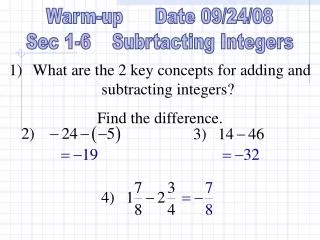
Warm-up Date 09/24/08 Sec 1-6 Subrtacting Integers • What are the 2 key concepts for adding and subtracting integers? • Find the difference.
Date 10/12/09 Sec 1-7 Inductive Reasoning
Goal: • To write rules for patterns • To make predictions and test conjectures
...And Why To use inductive reasoning in finding patterns and in making conjectures about economic data.
Key Words Inductive reasoning: Making conclusions based on patterns you observe. Conjecture: A conclusion you reach by inductive reasoning. Counterexample: An example that proves a statement false.
Use inductive reasoning. Make a conjecture about the next figure in the pattern. Then draw the figure. The next figure will have a shaded circle at the top right.
Write a rule for each number pattern. Start with 0 and subtract 4 repeatedly. Alternate 2 and its opposite. Start with 1. Alternate multiplying by 3 and adding 1.
Write a rule for each number pattern. Start with 4 and add 5 repeatedly. Start with 3 and multiply by 3 repeatedly. Start with 1,1. Then each number is the sum of the previous 2 #s
Incorrect; Is each conjecture correct or incorrect? If it is incorrect, give a counterexample. a) All birds can fly. Incorrect; an ostrich cannot fly. b) Every square is a rectangle. Correct c) The product of 2 #s is never less than either of the #s.
Did we achieve our goal? • To write rules for patterns • To make predictions and test conjectures
On-Line Help Web Site: PHSchool.com Tutor Web Code: ade-0202 Quiz Web Code: ada-0202
Planner: • Write today’s goal. • Write today’s assignment.
Assignment: • Practice 1-7 • Reflective Journal