Analyzing International Relations: Realism, Liberalism, and State Behavior
This article delves into the complexities of international relations through the lenses of realism, liberalism, and idealism. It explores the historical context post-World War II, focusing on Morgenthau's insights and Wilsonian idealism. Key tenets of realism are highlighted as analytic theories, emphasizing the anarchic nature of the international system and the rationale behind state behavior as unitary actors. Discussions include the concept of national interest and strategies for dealing with power dynamics, urging a pragmatic approach over ideological considerations.

Analyzing International Relations: Realism, Liberalism, and State Behavior
E N D
Presentation Transcript
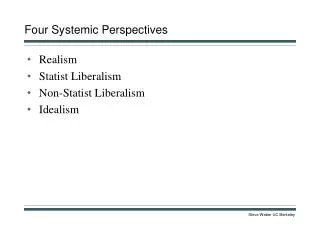
Four Systemic Perspectives • Realism • Statist Liberalism • Non-Statist Liberalism • Idealism
Realism • The historical context • Morgenthau and the end of World War II • The experience of Wilsonian idealism
Realism as an Analytic Theory • Politics is about conflict, and conflict is governed by objective laws that have their roots in human nature. • The international system is anarchic. • States seek to enhance their security by accumulating power
Realism as an Analytic Theory • States can be thought of as unitary actors. • States, as unitary actors, calculate their interests in a rational manner.
The key analytic insight: • State behavior is driven first and foremost by the external environment in which the state exists.
Realism as a Normative Theory • Realpolitick • Prudent assessments, preservation and use of power in the service of national interest • Ignore ideology • Ignore absolutist ethics • But what is the national interest?
Kissinger and the National Interest • Deal with governments not societies • Deal with power not intentions • Deal with real behavior not rhetoric • Deal with real threats -- which means making peace with your enemies not with your friends.