
Uploaded by
chandler
1 SLIDES
139 VUES
10LIKES
Exploring Weak and Strong Lensing in Massive Clusters using LoCuSS Data
DESCRIPTION
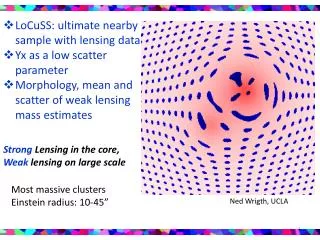
This study utilizes the LoCuSS dataset to analyze weak and strong lensing effects in massive galaxy clusters. We focus on the low scatter parameter Yx and investigate the morphology, mean, and scatter of weak lensing mass estimates. Our findings highlight the characteristics of strong lensing in cluster cores and the behavior of weak lensing on larger scales, with a specific emphasis on the Einstein radius, which measures the extent of gravitational lensing.
Download
1 / 1
Télécharger la présentation 
Exploring Weak and Strong Lensing in Massive Clusters using LoCuSS Data
An Image/Link below is provided (as is) to download presentation
Download Policy: Content on the Website is provided to you AS IS for your information and personal use and may not be sold / licensed / shared on other websites without getting consent from its author.
Content is provided to you AS IS for your information and personal use only.
Download presentation by click this link.
While downloading, if for some reason you are not able to download a presentation, the publisher may have deleted the file from their server.
During download, if you can't get a presentation, the file might be deleted by the publisher.
E N D
Presentation Transcript
LoCuSS: ultimate nearby sample with lensing data • Yx as a low scatter parameter • Morphology, mean and scatter of weak lensing mass estimates Strong Lensing in the core, Weak lensing on large scale Most massive clusters Einstein radius: 10-45” Ned Wrigth, UCLA
More Related