Download
1 / 11
110 likes | 227 Vues
This document provides a comprehensive overview of the Ground-Based Observatories (GBO) project led by H.U. Frey from the University of California, Berkeley. It highlights the collaborative efforts of various institutions, including UCLA and the University of Calgary, to monitor auroral lights and ionospheric currents across North America. The GBO aims to determine substorm onset timing and locations using a network of all-sky imagers and ground magnetometers. Requirements and objectives for GBO operations are also discussed, ensuring effective data collection and analysis.

E N D
Ground Based Observatories (GBO) Requirements and overview H. U. Frey University of California - Berkeley
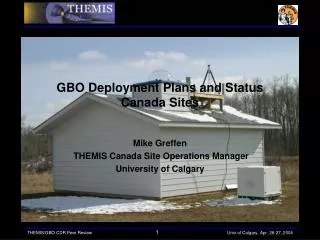
GBO Team Institutions • University of California – Berkeley (UCB) • S. B. Mende – GBO science lead • Provides ASI development, system engineering, GBO system fabrication and construction, data archive and dissemination, deployment of 4 stations in Alaska • University of California – Los Angeles (UCLA) • C. T. Russell – magnetometer science lead • Develop and provide ground magnetometer and GPS for GBO / EPO • University of Calgary • E. Donovan – Canadian science lead • Providing GBO system deployment (16 stations) in Canada, field management, data collection, development participation • University of Alberta • I. Mann – magnetometer scientist • Providing access to Canadian magnetometer network
GBO Site Locations • IMAGE FUV substorm onset identification 2000-2003. • Of 1173 events indicated within GBO longitude sector, 2% are outside the FoV of all-sky cameras
GBO Science Objective GBO shall monitor the auroral light and ionospheric currents across North America in order to localize the time, location, and evolution of the auroral manifestation of the substorm. Themis mission requirement relating to GBO: Determine substorm onset time and onset meridian magnetic local time (MLT) using All Sky Imagers (one ASI per MLT hr) and Ground Magnetometers (two GMAG per MLT hr) with t_res<30s and dMLT<1° respectively, in an 8hr geographic local time sector in North America.