Winning the War
Chapter 4 of "Winning the War" explores the pivotal moments of the American Revolutionary War, focusing on European allies like Friedrich von Steuben and Marquis de Lafayette. It details the British shift to Southern strategies following their defeat at Saratoga, including Cornwallis's capture of Charles Town and the enlistment of escaped slaves. The chapter culminates in the decisive American and French victory at Yorktown, leading to Cornwallis's surrender on October 17, 1781. The Treaty of Paris in 1783 recognized American independence, making the revolution a symbol of liberty and egalitarian ideals across the globe.

Winning the War
E N D
Presentation Transcript
Winning the War Chapter 4, Section 4
European Allies Shift the Balance Friedrich von Steuben-European military leader who helped train colonial troops. Marquis de Lafayette- French military leader who helps secure French aid.
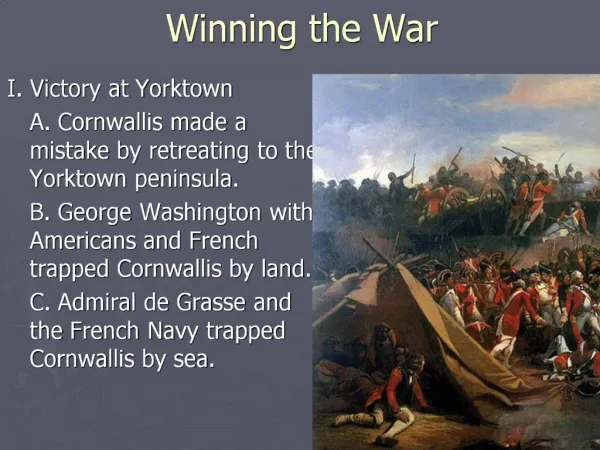
The British Move South British changed strategy after defeat at Saratoga. Shifted operations to the south where they hoped to rally Loyalist support. General Cornwallis captured Charles Town in 1780. Slaves escaped and joined the British side. General Cornwallis moved forces north into Virginia on the peninsula between the James and York rivers.
British Surrender at Yorktown American and French forces joined together to attack Cornwallis at Yorktown. French navy defeated British naval forces and blocked the entrance to Chesapeake Bay, preventing a British escape. Cornwallis surrendered on October 17, 1781 after 3 weeks of fighting. Treaty of Paris officially ends war in 1783- Britain agreed to full independence for the colonies.
The War Becomes a Symbol of Liberty American Revolution was inspirational around the world. Ideals of Egalitarianism were on the rise. Egalitarianism-belief in the equality of all people; one’s efforts or virtue defined their worth as a person, not their wealth or family. New independent nation now faced the challenge of setting up a democratic government that lived up to the ideals of the Declaration of Independence.