Download
1 / 18
180 likes | 300 Vues
This work delves into the complexities of children with athetosis, highlighting the fluctuating postural and muscle tone, as well as involuntary movements that characterize the condition. Athetoid movements are dissected into specific types, including pure athetosis and choreoathetosis. The etiology, including factors like jaundice, asphyxia, and metabolic disorders, is explored alongside associated challenges in speech, feeding, vision, and motor development. Management strategies are discussed, emphasizing the importance of tailored seating solutions and therapeutic approaches to enhance quality of life.

E N D
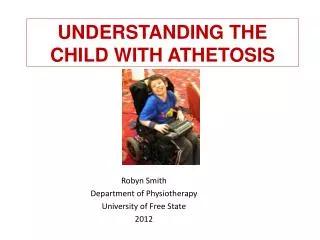
Robyn Smith Department of Physiotherapy University of Free State 2012 Understanding the child with athetosis
Athetoid group • NB!!! Characterised by: • Fluctuating postural/ • muscle tone • Involuntary movements Do not confuse with ATAXIA = in co-ordinated movements
Athetoid group Classified according to type of involuntary movementinto 4 groups • Pure athetosis • Choreoathetosis • Athetosis with dystonic spasms • Athetosis with spasticity
A look at muscle tone in the athetoid group Low tone Normal tone High tone Pure athetosis choreoathetosis Athetoid with dystonic spasms Athetoid with spasticity
Etiology • Kericterus hyperbilirubinaemia (severe jaundice) • Rh- incompatability • Prematurity • Asphyxia • Metabolic disorders • Encephalitis/ meningitis • Heavy metal poisoning • Rheumatic fever • Degenerative disorders brain
Etiology NB!!!!!= damage to the basal ganglia Basal ganglia are NB for: • Control of movement • Scale and amplitude determination of movement • Important in the control of eye movements
Characteristics • High IQ –cortex not involved • However usually severely disabled • Emotionally volatile • Often frustrated–temper tantrums • Lack of proximal stability • Poor grading movement • Poor balance • Muscle contractures usually not a concern • Due to constantly changing muscle tone and movement • Repetitive asymmetrical movement patterns may lead to deformities
Characteristics • Muscle tone fluctuates constantly • Inconsistent motor responses, child unsure of outcome of an action • General underlying hypotonia • Ligament laxity • Hypermobile
Athetoid • Most are wheelchair bound • Need lap and/or cross straps in the case of dystonic spasms to prevent the spasm from throwing them out of chair • Adequate trunk and foot support is critical to their stability
Seating : Shona Madiba buggy • Custom made to fit patient and meet specific support needs • Cost extremely expensive R 8000
Associated problems Speech & hearing • Vocalisation & speech problem –speech poor and indistinct • Often hearing loss • Can hear but does not listen due constant movement head Feeding • Difficulty in swallowing due to muscle incoordination • Battle especially with liquids and runny consistencies • Extreme difficulty in feeding safely
Associated problems Vision • Battle to focus • May have nystagmus = rapid, rhythmic, involuntary eye movements caused by damage brain • Eyes unable move independently head • Lack of stability of head affects vision
Development • Fluctuating tone present sometimes birth • Initially seem hypotonic • Develop extension pattern head, neck, retraction shoulders • Persistent ATNR • Due to involuntary movements fail to develop adequate head and trunk control Athetoid very intelligent and quickly learn to use pathological reflexes for function !!!! Habitual patterns
Development Prone • ATNR get up on one arm • TLR and STNR to get into M-sitting Sitting • Like to M-sit as is stable position • Uses ATNR for hand function • Chair –stabilises using arm around backrest or hooks foot around leg chair • Promotes further asymmetry resulting postural deformity
Development Gait • Struggle to learn to walk due to fluctuating tone, poor central control and involuntary movement • Asymmetry may be noted • Lumbar lordosis and anterior tilt due to poor central control • Knees locked together for stability • Arm held together or against leg for stability • Often appears in-coordinated
References • Brown, E. 2001. NDT basic course material (unpublished) • Smith, R. 2009. Paediatric dictate, UFS (unpublished) • Smith, R. 2008. role of physiotherapy in vestibular rehabilitation, PowerPoint presentation • Images courtesy of Google images (2009)