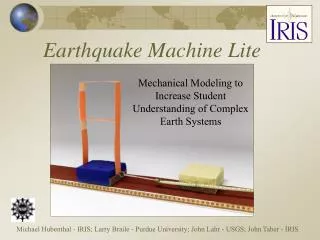
Earthquake Machine Lite
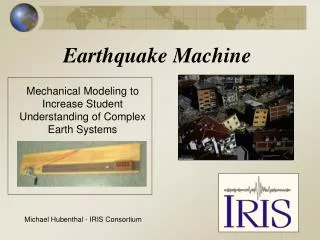
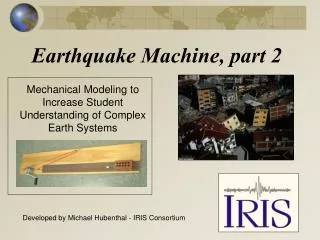
This educational resource, developed by Michael Hubenthal (IRIS), Larry Braile (Purdue University), John Lahr (USGS), and John Taber (IRIS), explores the complexities of earthquake mechanics using interactive modeling. Students will engage with essential questions such as, "What is an earthquake?" and "What role does modeling play in scientific inquiry?" By visualizing earthquake phenomena and the underlying elastic properties of Earth materials, this resource aids students in grasping how seismic moments are calculated and how scientific ideas evolve over time.

Earthquake Machine Lite
E N D
Presentation Transcript
Earthquake Machine Lite Mechanical Modeling to Increase Student Understanding of Complex Earth Systems Michael Hubenthal - IRIS; Larry Braile - Purdue University; John Lahr - USGS; John Taber - IRIS
Guiding Question(s) • What is an earthquake? • What is the role of a model in science? • How are scientific ideas constantly changing?
Calvin and Hobbes by Bill Watterson Have you even been outside at night and felt nervous or frightened?
Answer the following question on your sticky note… ? ? ? ? ? ? What is an Earthquake? ? ? ? ? ? ? ? ? ?
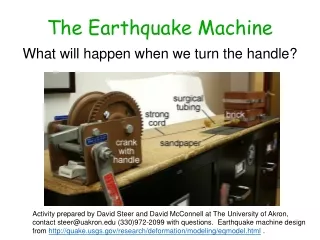
B EQ Machine - Lite Thin Tape Measure Sandpaper Top View C C Rubber Band Tape Measure Wood Block Guide Wood Block w/ Sandpaper
B EQ Machine - Lite Bulk of the Plate Top View C Elastic Properties of Earth Materials Plate has Constant Velocity Here of 1cm/year Edge of the Plate
Seismic Moment Mo = fault length x fault width x displacement x rigidity Moment Magnitude = Mw = log Mo/1.5 – 10.7
B Visualizing magnitude with the model Seismic Moment Mo = fault length x fault width x displacement x rigidity Moment Magnitude = Mw = log Mo/1.5 – 10.7
Elastic Rebound Theory Distant forces cause a gradual build up of stress in the earth over tens or hundreds or thousands of years, slowly distorting the earth underneath our feet. Eventually, a pre-existing weakness in the earth--called a fault or a fault zone--can not resist the strain any longer and fails catastrophically.