
Exotics & Glueballs
This study delves into the fascinating realm of exotic states predicted by Quantum Chromodynamics (QCD), including glueballs—mesons composed of bound gluons, hybrids with excited gluon states, and multiquark configurations. It examines the mass predictions from lattice QCD, explores the possible exotic quantum numbers (JPC) and experimental strategies to identify these states, such as central production and ppbar annihilation. The work highlights the challenges, expected signatures, and the significance of these states in the context of particle physics.

Exotics & Glueballs
E N D
Presentation Transcript
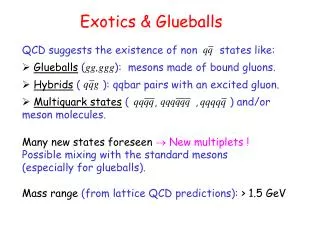
Exotics & Glueballs • QCD suggests the existence of non states like: • Glueballs (gg,ggg): mesons made of bound gluons. • Hybrids ( ): qqbar pairs with an excited gluon. • Multiquark states ( , , ) and/or meson molecules. Many new states foreseen New multiplets ! Possible mixing with the standard mesons (especially for glueballs). Mass range (from lattice QCD predictions): > 1.5 GeV
Exotic Signatures • Possible signatures for the exotics states: • Exotics quantum numbers JPC = 0+-, 1-+, 2+-, etc B=1 and S=1 (no standard baryons or mesons) • No place in the standard meson nonets • Decay width not compatible with QCD predictions for standard states • Enhanced production in gluon rich environments (for glueballs): • Central production • ppbar annihilation • J/ψ radiative decays • suppressed production (for glueballs)
1 2 Experimental strategy • For example for Glueball search one exploits the preferred production reactions like: • Central production (DPE)Results: WA102, Gams Future: GTeV (?) , HERAg (No) • ppbar annihilation Results: Obelix, Crystal Barrel,BNL Future: PANDA • J/ψ radiative decays Results: DM2, Mark Future:BES (?) • suppressed production Results: LEP experiments
Obelix For the quantum numbers dan the decay width determination coupled channel and spin-parity analyses are mandatory ! LH NP LP pp+-0 1.500.000 Ev. ppK+K-0 68.000 Ev. ppK±K0± 41.000 Ev.
* Morningstar & Peardon 1999 WA102 pp pp(K+K-) Glueballs • Lightest states predicted by Lattice QCD: JPC = 0++,2++,0-+ • Mass (G.B. West 1997): m(0++) < m(2++) < m(0-+) • -Mixing with the scalar nonet! • Best candidate for the 0++ glueball: f0(1500). E692 pp pp(KsKs) OBELIX (pp)1S0 p+p-p0 M2(+-)
Hybrids Light states predicted with Mass ~ 2GeV. Best candidates: E852 p-p hp-p OBELIX pp K±K0p±p+ p- Exotic number: JPC = 1-+ M = 1370 GeV Seen also by Crystal Barrel in the pn p-p0h reaction. η(1490): JPC = 0-+ Problem: the masses of the candidates are too low !
SPring-8 CLAS Multiquark states The anti-decuplet proposed by Diakonov, Petrov & Polyakov (Z.Phys.A359 (1997) 305) with the three exotic baryons at the corners - requiring the indicated five valence quarks - and their decay modes. Masses: 1530 MeV and 2070 MeV Θ+(1530) → nK+ orpK0 uudds events ddssu uussd Ξ--→Ξ-π- or-K- Ξ+→Ξ0π+ or+K0 invariant mass [GeV/c2] Many evidence, but small significance. Not yet clear !
Molti candidati e molto lavoro da fare per chiarire la situazione ! n=2 multipletti qq candidati chirali candidatistati gluonici candidati ibridi candidati 4 quark n=1