Add to your ISN…
60 likes | 200 Vues
This resource explores the distinction between primary and secondary sources, offering insights into their characteristics and examples. Primary sources present raw, firsthand accounts of events—such as original artwork, diaries, or photographs—while secondary sources interpret or analyze these materials, such as textbooks and biographies. The document includes reflection activities and prompts for learners to effectively engage with the material, facilitating a deeper understanding of historical research methodologies. Together, we will review what defines these sources and their relevance in academic studies.


Add to your ISN…
E N D
Presentation Transcript
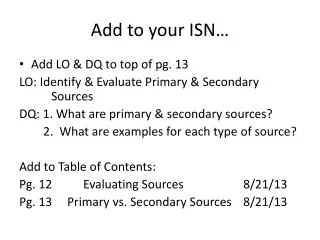
Add to your ISN… • Add LO & DQ to top of pg. 13 LO: Identify & Evaluate Primary & Secondary Sources DQ: 1. What are primary & secondary sources? 2. What are examples for each type of source? Add to Table of Contents: Pg. 12 Evaluating Sources 8/21/13 Pg. 13 Primary vs. Secondary Sources 8/21/13
Primary Sources • Records of events as they are first described • Artifact has not been changed in any way • No interpretations or commentary Examples: -Original artwork -Slave’s Diary -Photograph
Secondary Sources • Offers a description or restatement of primary sources Examples: -Book about the Underground Railroad -History Textbook -Biography of a historical figure
Reflection Activity (pg. 12)-Worksheet • We will check our answers together….
Bottom of pg. 12(Summary Section) • What are primary & secondary sources? • What are examples of each source? • Sentence Starter: A primary source is___________________________________. A secondary source is _________________.An example of a secondary source is ______________. An example of a primary source is ____________________________.