Understanding Groundwater: The Essential Resource Beneath Our Feet
Groundwater, a critical component of Earth's freshwater supply, makes up 23% of this vital resource. It exists in various forms: 12% is shallow and accessible, while 11% remains deep below the surface. Water infiltrates the ground, traveling through permeable layers like sand and gravel, and gets trapped by impervious layers such as clay or granite. This process leads to the formation of aquifers, which can store water for thousands of years. By grasping concepts like permeability, porosity, and the water table, we can better appreciate groundwater's role in supporting life and climate.

Understanding Groundwater: The Essential Resource Beneath Our Feet
E N D
Presentation Transcript
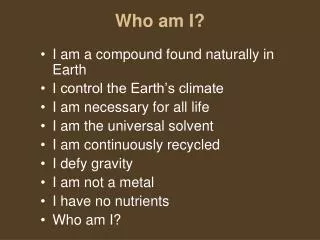
Who am I? • I am a compound found naturally in Earth • I control the Earth’s climate • I am necessary for all life • I am the universal solvent • I am continuously recycled • I defy gravity • I am not a metal • I have no nutrients • Who am I?
Groundwater • Makes up 23% of Earth’s freshwater. • 12% Shallow (we can reach) • 11% Deep (out of our reach)
Underground Layers When precipitation occurs, water often seeps down into the soil and trickles down in between particles of soil and through cracks and spaces in layers of rock.
Permeable and Impermeable Permeable layers allow water to travel through them. Ex: sand, soil, gravel Impermeable layers do not allow water to travel through them. Ex: clay, granite
Permeability • Rate that liquids go through pore spaces • Increases with porosity (NOT ALWAYS TRUE) • Holes must connect • IMPERMEABLE- liquid can’t get through
Permeable and Impermeable Pores- the spaces between rock which water can move through. Different kinds of rock have different-sized pores.
Trapped water When water reaches an impermeable layer, it is trapped and cannot go any further. The water begins to fill up the spaces above the layer.
Saturated Zone The area of permeable rock or soil that is totally filled with water.
Water Table The top of the saturated zone. Knowing the depth of the water table tells you how deep you must dig to reach the groundwater layer.
Unsaturated zone • The layers of rocks and soil above the water table.
Aquifer Any underground layer of rock or sediment that holds water is called an aquifer. People often obtain drinking water from aquifers. Water may stay in an aquifer for thousands of years before it well ever come to the surface!!!