Overview of the HFT Project: Advancements in Charm Meson Detection and Measurement Techniques
The HFT Project aims to advance the understanding of charm mesons through innovative detection techniques. Our approach focuses on compelling scientific questions, including elementary charm cross-sections, parton energy loss, and charm flow. We propose a new detector designed to perform crucial measurements. The team is structured for effective collaboration and includes experts from BNL, UCLA, MIT, and others. This review outlines our major milestones, the properties of the proposed detector technology, and strategies for integration, highlighting our commitment to timely and impactful science.

Overview of the HFT Project: Advancements in Charm Meson Detection and Measurement Techniques
E N D
Presentation Transcript
HFT Project Overview CD0 Review H.G. Ritter LBNL
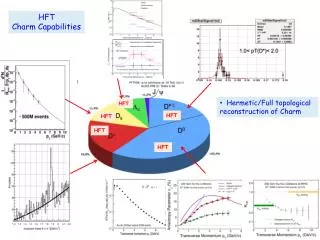
Compelling science • Elementary charm cross-sections • Parton energy loss • Charm flow and thermalization CD0 Review
Justification • In the first part we have shown • Compelling science • Proposed detector can do necessary measurements • In the second part we will show • Properties of detector • How we build it • We have the team and the organization to build it CD0 Review
Major Milestones • List all the previous reviews CD0 Review
Definition STAR Tracking Upgrade to identify D and B mesons through measurement of the displaced vertex CD0 Review
Optimal technology • New pixel technology • Resolution • Low material budget • Proven strip technology • Experience • Cost effective CD0 Review
PIXEL • 2 layers of 30x30 m pixels at 2.5 and 8 cm radius • Very thin material budget to limit multiple scattering • Data reduction and formatting on chip • Rapid insertion and removal • Precision positioning • Air cooling CD0 Review
PIXEL CD0 Review
Patch for run 11 CD0 Review
IST • One layer of single sided strips (pads) at a radius of 14 cm • Conventional and proven technology • MIT expertise CD0 Review
IST CD0 Review
SSD • Existing detector • Needs upgrade and TLC CD0 Review
Collaboration • BNL:C. Chasman, D. Beavis, R. Debbe, J.H. Lee, M.J. Levine, F. Videbaek, Z. Xu • UCLA:R. Cendejas, H. Huang, S. Sakai, C. Whitten • Kent State:J. Joseph, D. Keane, S. Margetis, V. Rykov, W.M. Zhang • Prague:M. Bystersky, J. Kapitan, V. Kushpil, M. Sumbera • Strasbourg:J. Baudot, C. Hu-Guo, A. Shabetai, M. Szelezniak, M. Winter • MIT:J. Kelsey, R. Milner, M. Plesko, R. Redwine, F. Simon, B. Surrow, G. Van Nieuwenhuizen • LBNL:E. Anderssen, X. Dong, L. Greiner, H.S. Matis, S. Morgan, H.G. Ritter, A. Rose, E. Sichtermann, R.P. Singh, T. Stezelberger, X. Sun, J.H. Thomas, V. Tram, C. Vu, H.H. Wieman, N. Xu • Purdue:A. Hirsch, B. Srivastava, F. Wang, W. Xie • U. Washington:H. Bichsel CD0 Review
HFT Management Structure DOE BNL LBNL HFT Project Management Contract Project Manager: HG Ritter (acting) LBNL Deputy, Contract Project Manager: RP Singh LBNL Deputy, Contract Project Manager: F. Videbaek BNL STAR Spokesperson: T. Hallman Upgrade coord: R. Majka Safety Coordinator TBD Pixel Det. Wieman LBNL Anderssen LBNL SSD Liaison J. Thomas LBNL Software S. Margetis KSU IST B. Surrow MIT J. Kelsey MIT Integration F. Videbaek BNL J. Kelsey MIT Management Structure CD0 Review
HFT Technical Committee Ritter - Project Manager Singh - Deputy Project Manager Morgan - Budget Videbaek - Integration Wieman - Pixel Anderssen - Pixel, Integration Surrow - IST Kelsey - IST, Integration Thomas - SSD Liaison Margetis - Software Hallman - STAR Majka - STAR Weekly meetings, change control CD0 Review
Risk Management • APS Sensor depending on Strasbourg pace of development • Push for early prototype, get involved in testing and design • Kinematic mount and low weight ladder challenging • Solve problem in the R+D phase • SSD is essential • Get involved in upgrade and running of SSD, design some redundancy into IST • HFT might become operational late • Build patch to test design and get early measurement CD0 Review
Cost CD0 Review
Proposed Schedule CD0 Review
Summary • Compelling Science • A detector • That can deliver the science • Has the right mix of new and proven technology • A team and an organization • That can build the detector • That will extract the science in a timely fashion CD0 Review