Enhance Your SQL Server Skills at SQLBits 2008: Key Insights and Innovations
Join us for a comprehensive exploration of SQL Server 2008 at SQLBits! Discover the latest features in Analysis Services, from improved MDX functionalities to the all-new Attribute Relationship Designer. Learn about ease of development with the updated BIDS and best practices for data mining. Gain access to insights from industry experts and networking opportunities. Don't forget to provide feedback after sessions and don’t miss out on our lunch-time discussions. Secure your tickets now for a chance to elevate your SQL Server experience!

Enhance Your SQL Server Skills at SQLBits 2008: Key Insights and Innovations
E N D
Presentation Transcript
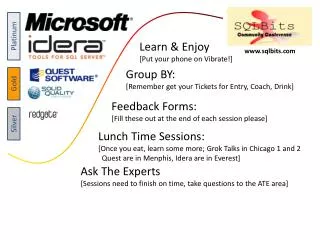
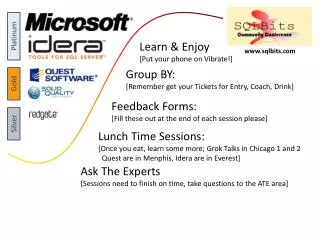
Platinum Learn & Enjoy [Put your phone on Vibrate!] www.sqlbits.com Group BY: [Remember get your Tickets for Entry, Coach, Drink] Gold Feedback Forms: [Fill these out at the end of each session please] Silver Lunch Time Sessions: [Once you eat, learn some more; Grok Talks in Chicago 1 and 2 Quest are in Menphis, Idera are in Everest] Ask The Experts[Sessions need to finish on time, take questions to the ATE area]
What’s New in Analysis Services 2008? Chris Webb Crossjoin Consulting Limited / Solid Quality Mentors chris@crossjoin.co.uk
The short answer… …nothing much!
Agenda • Making development easier • MDX • Engine performance improvements • Manageability • Data Mining
Best Practices Built-In • The best practices seen in SQL2005 BPA have now been built into BIDS • This means that if you make a questionable design decision, BIDS will display a blue squiggly line • Luckily this can be turned off
Attribute Relationship Designer • It is now much easier to design attribute relationships in dimensions, and much more obvious that you should do so • There is a new Attribute Relationship designer tab in the dimension editor, which allows you to visualise and edit relationships • Install BIDS Helper if you want something similar for AS2005
Aggregation Designer • Similarly, it will now be possible to view and design aggregations manually within BIDS • Although again this is currently possible with BIDS Helper or the Aggregation Manager sample app • BIDS will be able to validate manual aggregation designs to make sure that you don’t do anything stupid • The Aggregation Design Wizard algorithm will also be improved
Minor MDX Changes • Several minor changes have been made to MDX to fix omissions in AS2005 • The CREATE MEMBER and CREATE SET statements now allow you to specify • Display folders • Associated measure groups • There’s also a new CREATE KPI statement for declaring KPIs
UPDATE MEMBER Statement • You can now change the definition of calculated members defined with session scope using the UPDATE MEMBER statement • Note this does not work with calculated members defined on the cube • As a result, of very limited usefulness
Dynamic Sets • You can now declare named sets which are evaluated on a per-query basis in the context of the WHERE clause and subselects • They are not fully dynamic though – they are only evaluated once per query • This limits their usefulness, although they mightstill be ableto improve the performance of some calculations
Programmability • ADOMDServer namespace has some cool new personalisation features • You can get a reference to the current connection and user name • You can access events such as SessionOpened, SessionClosing, CubeOpened, CubeClosing • You can create calculations for the current session
Block Computation • Block Computation, aka Bulk Evaluation, is a more efficient way for the AS Storage Engine to retrieve sparse data from a partition • AS2005 can only use it some of the time, for example when Non_Empty_Behavior is used • AS2008 will aim to use it almost all the time, so queries that are currently slow will (hopefully) be faster
Scale-Out Scenarios • It will be possible to connect a single read-only database to multiple AS instances • Will make scaling out much easier – no need for synchronising servers
Improved Backup Performance • Backup times for AS2005 databases increase exponentially for sizes over 20Gb • AS2008 backup times should grow in proportion to the size of the database
MOLAP Writeback • Writeback in AS2005 involves allocating values down to fact table granularity then writing rows back to a relational table • This is often slooooooooow • Even PerformancePoint doesn’t use AS writeback • AS2008 should be able to write values back direct to a MOLAP partition, which will be faster
Data Management Views • DMVswill expose information currently available through XMLA commands as relational structures • Make it easier for DBAs to see who is connected, look for runaway queries etc • Also should be easier to get at this information in tools such as SSRS and SSIS
Data Mining • Time series algorithm is now optimised for long term as well as short term predictions • You will be able to automatically split data into testing and training data sets • You will also be able to filter data within a single data mining structure
Platinum www.SQLBits.com[Conference Web site] www.sqlbits.com www.SQLBlogCasts.com[Becoming the premier Blogging site for SQL professionals] Gold www.SQLServerFAQ.com[UK SQL Server Community Website] Silver UK SQL Bloggers cwebbbi.spaces.live.comsqlblogcasts.com/blogs/simonssqlblogcasts.com/blogs/tonyrogerson Remember :: Feedback Forms!!