Comprehensive Overview of Hydramethylnon: Usage, Toxicology, and Chemical Properties
Hydramethylnon is an insecticide primarily used in baits targeting cockroaches and fire ants. It has been registered by the US EPA since 1908, with various commercial formulations such as Wipeout and Siege. While hydramethylnon is low in toxicity to mammals and birds, it poses a significant risk to freshwater fish. Its rapid decomposition in water lessens exposure risks. The chemical formula is C25H24F6N4, with a molecular mass of 494.50 g/mol and a melting point of 185-190 °C. This overview summarizes its use, toxicology, and characteristics.

Comprehensive Overview of Hydramethylnon: Usage, Toxicology, and Chemical Properties
E N D
Presentation Transcript
Kiana and Ryan Hydramethylnon
Overview • “Hydramethylnon is an insecticide used primarily in baits for cockroaches and ants—notably fire ants. Since 1908, the US Environmental Protection Agency has registered 28 commercial insecticides that contain hydramethylnon, including some with such descriptive names as Wipeout and Siege. Hydramethylnon is practically nontoxic to mammals, birds, and honeybees. It is highly toxic to some freshwater fish, but exposure is rarely a problem because it decomposes rapidly in water.” http://portal.acs.org/portal/acs/corg/content?_nfpb=true&_pageLabel=PP_ARTICLEMAIN&node_id=841&content_id=CNBP_029311&use_sec=true&sec_url_var=region1&__uuid=2ad380ba-5c40-4362-8389-0000ae50ca25
Toxicology • Oral, rat: LD50 is 1100–1300 mg/kg. • Oral, dog: LD50 is above 28000 mg/kg. • Hydramethylnon is especially toxic to fish; the 96-hour LC50 in rainbow trout is 0.16 mg/L, 0.10 mg/L in channel catfish, and 1.70 mg/L in bluegill sunfish.
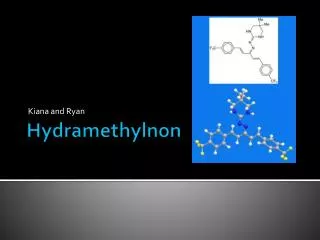
Facts • Chemical formula: • C25H24F6N4 • Molecular Mass: • 494.50 g/mol • Density: • Bulk density 1.67 (g ml-1) • Appearance: • yellow to orange crystalline solid • Melting Point: • 185-190 °C • Insoluble
http://en.wikipedia.org/wiki/Hydramethylnon http://www.wolframalpha.com/entities/chemicals/hydramethylnon/68/1p/if/ http://sitem.herts.ac.uk/aeru/footprint/en/Reports/386.htm http://www.youtube.com/watch?v=F7F3cH4Rukg