Guidelines for Praise
Guidelines for Praise. Effective Praise Is delivered contingently Specifies the particulars Shows spontaneity, variety, and other signs of credibility Rewards attainment of specified performance criteria
Guidelines for Praise

E N D
Presentation Transcript
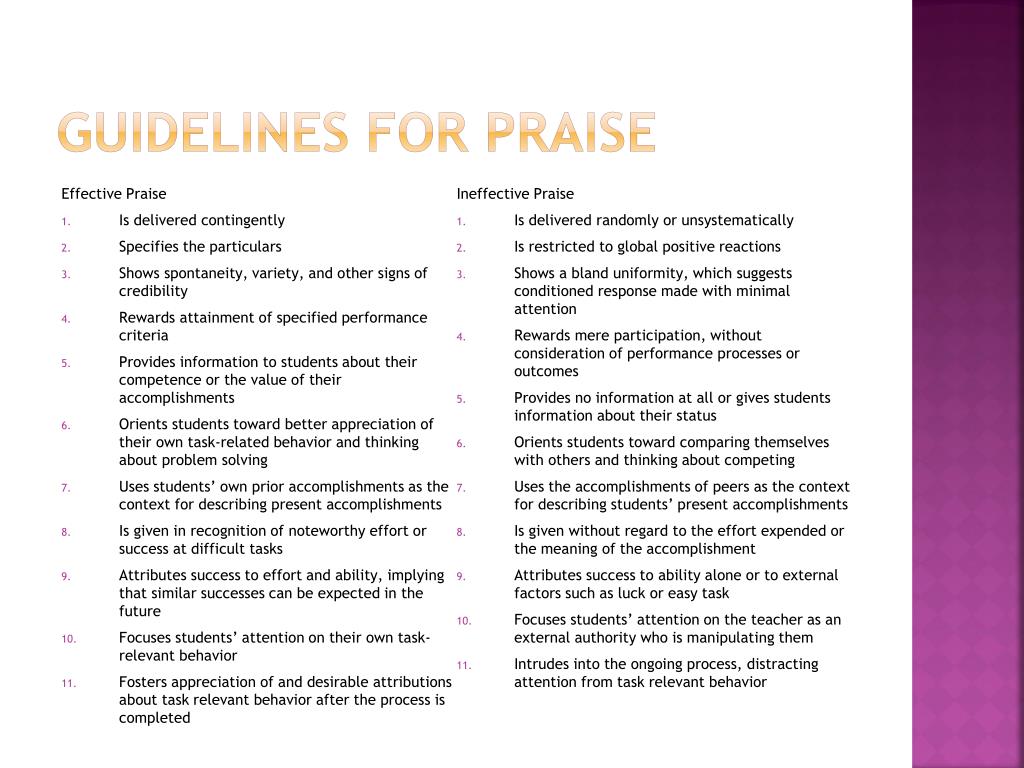
Guidelines for Praise Effective Praise • Is delivered contingently • Specifies the particulars • Shows spontaneity, variety, and other signs of credibility • Rewards attainment of specified performance criteria • Provides information to students about their competence or the value of their accomplishments • Orients students toward better appreciation of their own task-related behavior and thinking about problem solving • Uses students’ own prior accomplishments as the context for describing present accomplishments • Is given in recognition of noteworthy effort or success at difficult tasks • Attributes success to effort and ability, implying that similar successes can be expected in the future • Focuses students’ attention on their own task-relevant behavior • Fosters appreciation of and desirable attributions about task relevant behavior after the process is completed Ineffective Praise • Is delivered randomly or unsystematically • Is restricted to global positive reactions • Shows a bland uniformity, which suggests conditioned response made with minimal attention • Rewards mere participation, without consideration of performance processes or outcomes • Provides no information at all or gives students information about their status • Orients students toward comparing themselves with others and thinking about competing • Uses the accomplishments of peers as the context for describing students’ present accomplishments • Is given without regard to the effort expended or the meaning of the accomplishment • Attributes success to ability alone or to external factors such as luck or easy task • Focuses students’ attention on the teacher as an external authority who is manipulating them • Intrudes into the ongoing process, distracting attention from task relevant behavior