SlideServe
Menu
Préférences
© SlideServe · v2026

The installer for Kepler 1.6a is available for download at kepler-project

chin avatar
1 diapositives · 211 Views · Oct 09, 2014

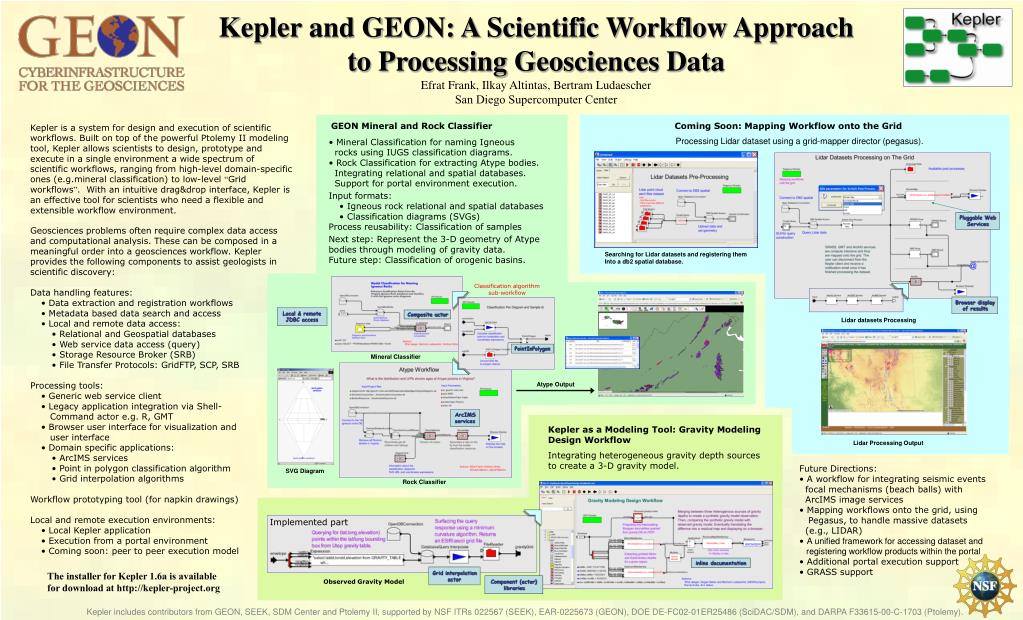
Kepler and GEON: A Scientific Workflow Approach to Processing Geosciences Data Efrat Frank, Ilkay Altintas, Bertram Ludaescher San Diego Supercomputer Center. GEON Mineral and Rock Classifier. Coming Soon: Mapping Workflow onto the Grid.
The installer for Kepler 1.6a is available for download at kepler-project - slide 1
01 / 1The installer for Kepler 1.6a is available for download at kepler-project
1 / 17

Télécharger la présentation

The installer for Kepler 1.6a is available for download at kepler-project
Une image / un lien ci-dessous est fourni (tel quel) pour télécharger la présentation

Politique de téléchargement : le contenu du site vous est fourni TEL QUEL pour votre information et votre usage personnel ; il ne peut être vendu, concédé sous licence ni partagé sur d’autres sites sans l’accord de son auteur.Le contenu vous est fourni TEL QUEL, pour votre information et votre usage personnel uniquement. Téléchargez la présentation en cliquant sur ce lien. Lors du téléchargement, si vous ne parvenez pas à télécharger une présentation, l’éditeur a peut-être supprimé le fichier de son serveur.Pendant le téléchargement, si vous ne parvenez pas à obtenir une présentation, le fichier a peut-être été supprimé par l’éditeur.

F I N

Plus de contenu associé

Transcription de la présentation
  1. Kepler and GEON: A Scientific Workflow Approach to Processing Geosciences Data Efrat Frank, Ilkay Altintas, Bertram Ludaescher San Diego Supercomputer Center GEON Mineral and Rock Classifier Coming Soon: Mapping Workflow onto the Grid Processing Lidar dataset using a grid-mapper director (pegasus). • Mineral Classification for naming Igneous rocks using IUGS classification diagrams. • Rock Classification for extracting Atype bodies. Integrating relational and spatial databases. Support for portal environment execution. Input formats: • Igneous rock relational and spatial databases • Classification diagrams (SVGs) • Process reusability: Classification of samples • Next step: Represent the 3-D geometry of Atype bodies through modeling of gravity data. • Future step: Classification of orogenic basins. Classification algorithm sub-workflow Pluggable Web Services Mineral Classifier Searching for Lidar datasets and registering them Into a db2 spatial database. Browser display of results Local & remote JDBC access Composite actor Lidar datasets Processing PointInPolygon Rock Classifier Atype Output ArcIMS services Kepler as a Modeling Tool: Gravity Modeling Design Workflow Integrating heterogeneous gravity depth sources to create a 3-D gravity model. Lidar Processing Output SVG Diagram Implemented part inline documentation Grid interpolation actor Component (actor) libraries Observed Gravity Model Randy Keller, Ann Gates Kepler is a system for design and execution of scientific workflows. Built on top of the powerful Ptolemy II modeling tool, Kepler allows scientists to design, prototype and execute in a single environment a wide spectrum of scientific workflows, ranging from high-level domain-specific ones (e.g.mineral classification) to low-level “Grid workflows”. With an intuitive drag&drop interface, Kepler is an effective tool for scientists who need a flexible and extensible workflow environment. • Geosciences problems often require complex data access and computational analysis. These can be composed in a meaningful order into a geosciences workflow. Kepler provides the following components to assist geologists in scientific discovery:Data handling features: • Data extraction and registration workflows • Metadata based data search and access • Local and remote data access: • Relational and Geospatial databases • Web service data access (query) • Storage Resource Broker (SRB) • File Transfer Protocols: GridFTP, SCP, SRB • Processing tools: • Generic web service client • Legacy application integration via Shell- Command actor e.g. R, GMT • Browser user interface for visualization and user interface • Domain specific applications: • ArcIMS services • Point in polygon classification algorithm • Grid interpolation algorithms • Workflow prototyping tool (for napkin drawings) • Local and remote execution environments: • Local Kepler application • Execution from a portal environment • Coming soon: peer to peer execution model • Future Directions: • A workflow for integrating seismic events focal mechanisms (beach balls) with ArcIMS image services • Mapping workflows onto the grid, using Pegasus, to handle massive datasets (e.g., LIDAR) • A unified framework for accessing dataset and registering workflow products within the portal • Additional portal execution support • GRASS support The installer for Kepler 1.6a is available for download at http://kepler-project.org Kepler includes contributors from GEON, SEEK, SDM Center and Ptolemy II, supported by NSF ITRs 022567 (SEEK), EAR-0225673 (GEON), DOE DE-FC02-01ER25486 (SciDAC/SDM), and DARPA F33615-00-C-1703 (Ptolemy).