Download
1 / 6
60 likes | 198 Vues
This comprehensive behavior tracking guide helps caregivers monitor and assess children's play interactions and aggression levels throughout the week. It includes sections for recording cooperative play, instances of aggression, and peer interactions. Caregivers can evaluate problem behaviors and summarize play activities, allowing them to identify patterns, triggers, and areas needing attention. By documenting the child's name, observational data, and average durations, the guide aids in fostering positive social interactions and addressing behavioral challenges effectively.

E N D
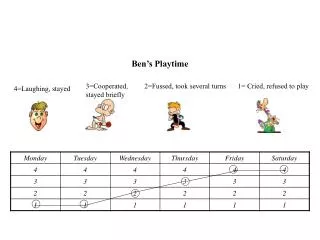
Ben’s Playtime 3=Cooperated, stayed briefly 2=Fussed, took several turns 1= Cried, refused to play 4=Laughing, stayed
Amy’s Difficulties Week of _____________ Rate the problem behavior: 0=no problems, 1 = whining, resisting , 2= screaming, falling on floor, 3=screaming, hitting, other aggression
Average AggressionChild’s Name: ______________ Week of: _________________Check the number of times the child is aggressive during the activity. Aggression includes: hits, pinches, pulls hair, bites, kicks, & scratches.
Average DurationChild’s Name: ______________________ Behavior: ____sitting______Week of: _________________ Average Duration for Week: ___9_____ minutesStarting from the bottom, shade the number of boxes that represent the length of the target behavior. Each box represents TWO minutes.
Peer InteractionChild’s Name: ______________ Observer: ___________________ Check yes (Y) or no (N) at time one (T1) and time two (T2) to indicate whether the child is interacting with a peer at the time of observation.T1 and T2 observations should be at least 5 minutes apart.
Play Behavior Child’s Name: _____________________ Week of: _________ Time: ___:___--___:___Indicate play behavior at the beginning, middle, and end of each play period. Summarize play behavior by placing totals in summary column. Weekly Total ___Not Playing ___Play with toy alone ___Play with toy with peer