DNA Replication
DNA replication is a critical process that enables cells to produce new cells and maintain genetic integrity. As our cells constantly regenerate—like skin, red blood cells, and white blood cells—DNA must be accurately copied to ensure each new cell retains the same genetic information. The process involves unzipping the double helix and using each strand as a template for building new complementary strands, resulting in two identical DNA molecules. With the action of enzymes like DNA polymerase and proofreading mechanisms, replication is accomplished rapidly and with remarkable accuracy.

DNA Replication
E N D
Presentation Transcript
Why Does DNA Need to Replicate? • Your cells are constantly dying and being replaced! • White blood cells live for about a year • Red blood cells live about 4 months • Skin cells last 2-3 weeks • Sperm cells die after 3 days • Every time your cells divide to produce new cells, DNA must be copied.
` “It has not escaped our notice that the specific [base] pairing we have postulated immediately suggests a possible copying mechanism for the genetic material.” -Watson and Crick
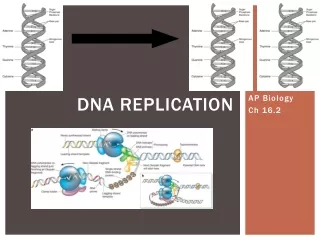
Replication • Nitrogenous bases pair only in one way (A-T, C-G) • One DNA strand serves as a template for a new strand • Replication- the process by which DNA is copied • Ensures that all cells in your body have the same set of genetic information
How is Replication Carried Out? • Enzymes and other proteins help replicate DNA molecules • Replication overview: • Double helix is “unzipped” • Single strand is used as template to build a new, complementary strand • DNA polymerases attach nucleotides to the DNA strand • Results in two identical copies of the DNA molecule
Replication Process • DNA helicase (an enzyme) unzips the DNA strands at multiple places along the molecule. • These are called replication forks or origins of replication
Replication Process • Another enzyme called DNA polymerase bond free-floating nucleotides in the nucleus to their complementary bases on the DNA template strand.
Result of Replication • Two identical double-stranded DNA molecules • Replication is semiconservative • Each new molecule contains one original strand and one new strand
Replication Process • Replication is fast and accurate • Multiple replication forks in eukaryotes allows replication to be completed in just a few hours
Do Mistakes Ever Occur? • DNA polymerase “proofreads” as it goes • Occasionally, it adds the wrong base but can usually detect the error and correct it before moving on. • Replication errors happen only about 1 time per billion nucleotides.