
Karl Marx & communism
Explore the concepts of Karl Marx's communism and its comparison with a dystopian novel, analyzing similarities, analogies, and differences. Discover how the novel's society is stuck in the first phase of communism and why it has remained unchanged for so long.

Karl Marx & communism
E N D
Presentation Transcript
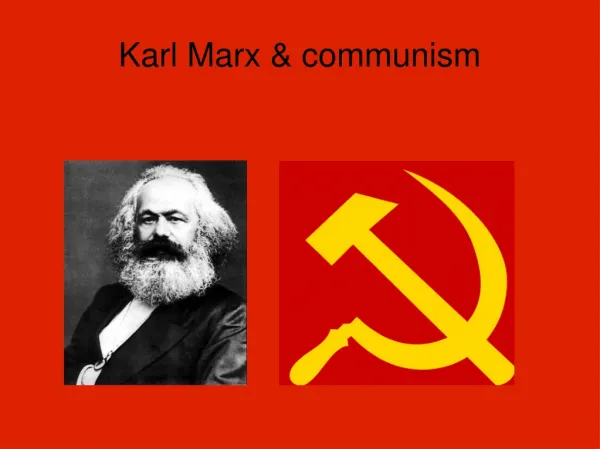
Karl Marx • May 5, 1818 – March 14, 1883 • philosopher, political economist, sociologist, humanist, political theorist and revolutionary • Often called “father of communism“ • “Workers of all lands, unite!“
communism • Socioeconomic structure (deals with economic activity and social life) • Characteristics: egalitarian, classless, stateless society, based on common ownership • Idea: working class (proletarians) to replace the wealthy, ruling class (bourgeoisie) • Different forms: e.g. Marxism (most influential), Leninism, Stalinism, Maoism
Marxism • 2 phases of development • 1st phase: productive property becomes owned in common, some class-differences remaining • 2nd phase / „higher phase“: full realisation of communism's ideas, a state is no longe requiered
Analogies: novel - Marxism • “Everybody belongs to everybody“ (novel) - „Everything belongs to everybody“ (marxism, common ownership) • Novel: people are considered objects (artificial insemination -> people are „produced“) • Communism: each gives according to his abilities and receives according to his needs – novel: abilities and needs are prefabricated
Differences: novel - Marxism • Main difference: novel: no freedom, predestination, no individuality – Marxism: personal freedom • Novel: caste-system, no equality – Marxism: no differences among people • Communism: Society regulates production (indivdual consumption) – novel: industry regulates production (predefined consumption → capitalism
Conclusion • Basic structures of communism / Marxism have been taken over (e.g. common ownership) • Novel is „stuck“ in Marxism's 1st phase (e.g. remaining class differences) • Has been developed for a long time → „enhanced“ 1st phase
