Nursing Process- Assessment
The nursing process is a systematic, goal-driven approach that guides patient care. It involves identifying patient needs, establishing care goals, planning, implementing, and evaluating care. The assessment phase is crucial, as it serves as the foundation for data collection, including nursing history, physical exams, and lab tests. Essential data should be descriptive, concise, complete, and validated. Methods of data collection encompass interviews and physical examinations, utilizing various techniques to obtain comprehensive patient information.

Nursing Process- Assessment
E N D
Presentation Transcript
Overview of Nursing Process • Purpose of Nursing Process: • The nursing process guides our care, it helps us to identify the patient’s needs, establish goals of care, communicate our plan, and evaluate our care.
Characteristics of the Nursing Process • It has purpose, it is goal driven • It is organized • It is creative
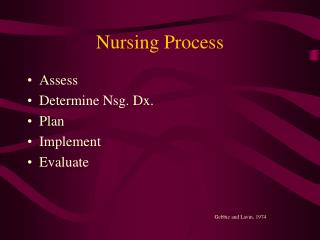
Steps of the Nursing Process • Assessment • Analysis (Nursing Diagnosis) • Planning • Implementation • Evaluation
Assessment- the first phase • Data collection phase • The purpose= establish a data base • Through assessment includes 3 parts: • 1) Nursing history • 2) Physical exam • 3) Lab/ diagnostic test data
Data • Data should be: • Descriptive • Concise • Complete • Data should be validated • Types of data • Subjective • Objective • Data should be organized • Gordon’s functional health patterns • Systems organization
Sources of Data • Client • Family or significant other • Health team members • Medical record • Literature review
Methods of Data Collection • Health history and interview • Interviewing steps • Introduction • Set a time limit • Ask if they have questions before starting • Assure confidentiality • Interview techniques • Problem solving • Problem seeking • Direct questions • Open-ended questions
Methods of Data Collection • Interview (continued) • 3 phases of interview • 1) Orientation • 2) Working • 3) Termination • Health history includes: • Bio info, reason for seeking health care, present illness, past health history, family history, environmental history, psychosocial history, review of systems
Methods of Data Collection • Physical Exam • Exam done systematically • Techniques used: • Inspection • Palpation • Percussion • Auscultation
Methods of Data Collection • Laboratory/ Diagnostic Tests • Ordered by physician based on symptoms or illness • Results are compared to established norms • Common lab tests: CBC, ABGs, FBS, UA, C & S, CXR, EEG, EKG