Introduction to Bonding
This comprehensive guide explores the fundamental concepts of chemical bonding, including ionic, covalent, and metallic bonds. Learn about ions, compounds, and the significance of bond polarity, electronegativity, and the characteristics that determine bond types. Detailed explanations support an understanding of the formation of different structures, such as molecular formulas and crystalline lattices. This resource is essential for students and educators seeking to grasp the nuances of how atoms interact and combine to form various substances.

Introduction to Bonding
E N D
Presentation Transcript
Chemical Bonding Introduction to Bonding C. Johannesson
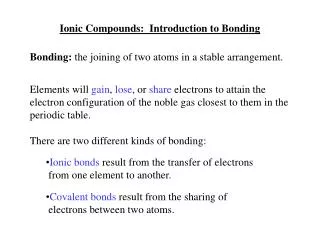
Vocabulary Ion an atom or group of atoms that carries an electrical charge Ionic Compound a compound that results from a transfer of electrons from one element to another C. Johannesson
Vocabulary Chemical Bond • attractive force between atoms or ions that binds them together as a unit • bonds form in order to… • decrease potential energy (PE) • increase stability C. Johannesson
Vocabulary CHEMICAL FORMULA IONIC COVALENT Formula Unit Molecular Formula NaCl CO2 C. Johannesson
Vocabulary COMPOUND more than 2 elements 2 elements Binary Compound Ternary Compound NaCl NaNO3 C. Johannesson
Vocabulary ION 2 or more atoms 1 atom Monatomic Ion Polyatomic Ion Na+ NO3- C. Johannesson
Types of Bonds COVALENT IONIC e- are transferred from metal to nonmetal e- are shared between two nonmetals Bond Formation Type of Structure true molecules crystal lattice Physical State liquid or gas solid Melting Point low high Solubility in Water yes usually not yes (solution or liquid) Electrical Conductivity no Other Properties odorous C. Johannesson
Types of Bonds METALLIC e- are delocalized among metal atoms Bond Formation Type of Structure “electron sea” Physical State solid Melting Point very high Solubility in Water no yes (any form) Electrical Conductivity malleable, ductile, lustrous Other Properties C. Johannesson
Bond Polarity • Most bonds are a blend of ionic and covalent characteristics. • Difference in electronegativity determines bond type. C. Johannesson
Bond Polarity Electronegativity • Attraction an atom has for a shared pair of electrons. • higher e- negatom - • lower e- negatom + C. Johannesson
Bond Polarity ElectronegativityTrend • Increases up and to the right. C. Johannesson
Bond Polarity Nonpolar Covalent Bond • e- are shared equally • symmetrical e- density • usually identical atoms C. Johannesson
- + Bond Polarity Polar Covalent Bond • e- are shared unequally • asymmetrical e- density • results in partial charges (dipole) C. Johannesson
Bond Polarity • Nonpolar • Polar • Ionic C. Johannesson View Bonding Animations.
Bond Polarity Examples: • Cl2 • HCl • NaCl 3.0-3.0=0.0 Nonpolar 3.0-2.1=0.9 Polar 3.0-0.9=2.1 Ionic C. Johannesson