Download

1 / 3
30 likes | 134 Vues
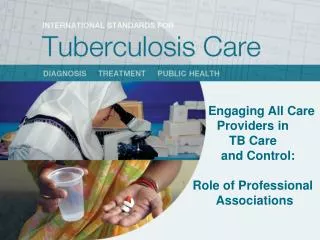
This discussion emphasizes the critical role of health professional associations in tuberculosis (TB) control. It highlights the need for these organizations to engage with National Tuberculosis Programs (NTPs) and transition from an academic focus to active public health involvement. Key steps include conducting a situation analysis, developing collaborative objectives, and establishing governance structures. Challenges in varying national contexts, such as the existence of multiple associations and the need for coordination with government health ministries, are addressed. Training future health professionals and advocating for effective legislation are also vital strategies.

E N D
Strengthening health professional associations to enable them to contribute to TB control Group 2 Facilitators: Dr Nevin Wilson, The Union and Dr Pierre-Yves Norval, WHO/HQ
Summary of Discussion • Professional associations are rather at an academic level – how to bring interface with NTP – need to transition to public health • Starting point: Identify possible role the professional associations can have • Series of steps: • Situation analysis, identify problems • Think how to work together – develop interests within associations : ISTC • Develop objectives of collaboration • Process: TOR, MOU • Need to have structure within NTP + Med Associations to oversee the functions • Challenge: • What in countries where no strong professional association ? • Should NTP initiate the collaboration? Yes, but not forming associations • What in countries where many associations – India: IMA accepted to form coalition among other organizations • Sensitivities between MOH and national medical associations • Lower income versus higher responsibilities with NTP collaboration • Myanmar: CCM = country leadership in recognizing medical associations • Chair : Minister • Vice Chair: MMA • Suggestion to start at Medical Schools to sensitize future members of professional associations • Suggestion to organize and train groups for case holding (Red Cross, youth groups, …) • Need to have consensus on ‘think globally’ but countries themselves ‘act locally’ • Start sensitization, then progress to training • Advocacy role in legislation (for example drug policy) • Advocacy role in guiding Government policy