Download
1 / 22
220 likes | 373 Vues
This presentation by Nupur Chowdhury discusses the regulatory framework for nanotechnology in India, highlighting the state’s ambivalence towards emerging technologies. It explores government initiatives, investment drivers, and existing legislation, emphasizing the need for a balanced approach to regulation. The analysis includes the implications of historical technological shifts and the importance of integrating environmental and safety concerns into future developments. Furthermore, it examines the regulatory landscape for biotechnology and ICTs, suggesting ways to enhance public participation and transparency in decision-making.

E N D
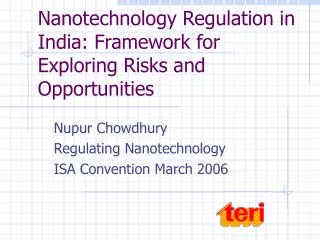
Nanotechnology Regulation in India: Framework for Exploring Risks and Opportunities Nupur Chowdhury Regulating Nanotechnology ISA Convention March 2006
Format of Presentation • Indian State: Regulatory Impetus for new emerging technologies • Drivers of Research Investment in Nanotechnology: Current Developments • Review of existing legislation and judicial prescriptions: implications for Nanotech Regulation • Some broad conclusions
Indian state and emerging technologies • Role of the state has been largely ambivalent - adoption of technological revolutions • Post independence – Cold War geopolitics – transfer of technology – energies focused on indigenisation of technologies acquired • Post Seventies – large scale public investment in capacity building – setting up of premier scientific educational establishments – failure to capitalize – investment unrelated to strategic research for commercialization
Regulating ICTs and Biotechnology • Nineties witnessed massive success of the telecom and then information technology – government major player – used entrepreneurial experience – to regulate • Strong regulatory posture missing in other areas – viz. biotechnology – despite govt. notification in 1989 – no practical implementation – unwilling regulator • State – caught between need to regulate investment & ensure public good – and pursuing rapid economic growth through private sector investment
Regulating ICTs and Biotechnology • Biotechnology – deliberate go slow – wrong signals to wary investors • Risk discourse within government regulation of emerging technologies – defensive reaction – widespread criticism • Confrontational posturing – zero sum game – government needs to engage with the public – transparency – right to information
Regulating nanotechnology • Government several steps to facilitate public sector investment – postponed regulatory initiatives – argument – nanotechnology is still at a nascent stage – stand dissimilar to that vis-à-vis gene technology • Nano science and and Technology Initiative – fundamental research program – focussing primarily on equipments research
Research Investment in nano technology • Nano Science and Technology Initiative (NSTI) – launched in Oct’ 2001 national program of Department of Science and Technology – Centers of Excellence • Nano Research – within government – DST, DRDO and the DBT – DST overall responsibility- unclear the reviewing authority of DST.
Research Investment in nano technology II • NSTI – four specific areas of research – distinct plan on the part of the government – focus research – areas of significant commercial results – identified areas – nano drug delivery systems – leverage India’s present leadership in drug manufacturing • Overt focus on commercialization – lead to neglect of research on environmental and safety aspects of nanotechnology
Research Investment in nano technology III • NSTI – four specific areas of research – distinct plan on the part of the government – focus research – areas of significant commercial results – identified areas – nano drug delivery systems – leverage India’s present leadership in drug manufacturing • Overt focus on commercialization – lead to neglect of research on environmental and safety aspects of nanotechnology
Government Initiatives • Currently research funded amounts to US $ 5 million – public – private partnership – few leads – Dr. Reddy’s • Soft loans – TIFAC and Technology board • International Collaborations – ARCI • Indo-US Science and Technology Forum
Regulatory Imperatives • Government’s position – guided by developmental impacts of nanotech research • Regulation – potentially problematic – disincentive private sector investment • Govt. – not unaware of moral, ethical and other issues – plan to sets up an expert body to deliberate on such issues • History of state policy committees – bureaucratic – little public participation
Regulatory Concerns • Unknown environmental & health impacts – adequate structures of risk assessment • Ensure investments – adequately focused on developing usages that would generate public goods like – clean environment • IPR – another area of regulatory oversight – market for adequately protected from monopolistic impulses
Existing Legislations and judicial prescriptions • Three essential touchstones – regulatory framework on nanotechnology: • Information requirements • Liability for environmental hazards – private investment in commercialization – matched by public investment ins studying enviro-health impacts • Transparency and public involvement – right to information – legal obligation
Legislative framework • Environment Protection Act 1986 • Hazardous Waste (Management and Handling) Rules 1989 • Manufacture, storage and import of hazardous chemical Rules 1989 • Bio-medical Waste Rules 1998 • Chemical Accidents Rules 1996 • Rules for manufacture, use, export, import, storage of microorganisms and GM organisms 1989
Legislative framework II • Water (Prevention and Control of Pollution) Act • Air (Prevention and Control of Pollution) Act • Public Liability Insurance Act 1991 • Food Safety and Standards Bill 2005
Judicial Prescriptions • Hazardous Substances: Court has evolved a rule of absolute liability • Precautionary Principle: • Reversal of burden of proof • Technical capacity of appellate tribunals • Appellate body not restricted by Wednesbury limitations – strong presumption administrative decisions challenged on lower standard of unreasonableness – non-application of precautionary principle
Few Broad Conclusions • Several developments – NSTI – government spearheading – opportunity to attract investment • Rapid developments within nanotechnology – high chance of filtration – government oversight required - potentially hazardous • Applications of nanotechnology – growing at a phenomenal space – difficult for regulators to keep pace unless work in tandem • Regulatory oversight – necessary – give direction to research efforts
Conclusions II • Role of the government as regulator – government needs to play a more proactive role- public research investments in studying effects of nano materials – health and environment • Rationalization of current legislative structure – if we want to make it applicable to nanotechnology • Contribution of present legislation – huge reservoir of regulatory experience • Reiterate transparency and public involvement
Possible research areas • Existing regulatory policy as a possible framework for nanotech regulation: • REACH, SPS, TRIPS, ISO, ICC • National legislative framework and potential for developing nano governance structures (comparitive perspective): • Office of Mngt. & budget – cost benefit analysis • Indian – political economy considerations
Possible research areas II • Soft Law Approaches: • Private co driven codes of conduct and research standards – e.g. Dupont – also study similar initiatives in other sectors and how far have they shaped hard law or substituted for hard law • International regulatory impetus: • WHO, UNEP, WTO (“collective preference”) • Expert Committees (information requirements) – e.g. IPCC – major differences.
Possible research areas III • Agricultural biotechnology and Nanotechnology: Similarities and differences – could shape regulatory structures and consumer perceptions. • Military applications of nanotechnology: • Massive area of investment – will also to an extent shape regulatory structures – secrecy • Regulatory certainty is imperative – huge investment – minimize the risks – could either be soft or hard law