Are You Prepared? A Geo-Guide for Navigating Underground Risks in Construction Projects
This comprehensive geo-guide, "Are You Prepared?", equips non-specialists such as principals, architects, and real estate developers with critical insights into underground risks encountered during construction. With a focus on the Netherlands, this guide highlights essential risk management strategies and when to engage geotechnical specialists. It covers common subsurface challenges, such as groundwater issues, local vulnerabilities, and material composition, drawing from real-case examples like the Conservatorium Hotel and University Medical Center Groningen. Don’t hide from underground risks; face them with informed decision-making.

Are You Prepared? A Geo-Guide for Navigating Underground Risks in Construction Projects
E N D
Presentation Transcript
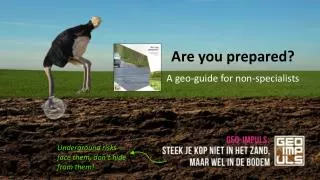
Are youprepared? A geo-guide for non-specialists Underground risks – face them, don’thidefromthem!
Who’sitfor? For you: the principal, the architect, the realestatedeveloper (Fromus: the geotechnicalspecialist) • You have building plans • With time, quality and budget requirements • Youneedspecialists – youcan’tknoweverything • Keyquestion: When to call the specialist?
Building is not risk-free • You are going to build villas in a residential area, an underground parking lot, a new town hall, … • You are aware of the risks and, of course, you have risk management procedures (e.g. ISO 31000) • Nevertheless pitfalls remain: traffic control systems are one (many tunnel projects) • The subsurface is also a common pitfall, especially in soft sedimentary soils of the kind found in the Netherlands
Risks are not a problem as long as you seethem • Recommendation to “call the specialist” is right as far as it goes, but it is not helpful … • …because: in which cases and when? • We want to bridge the gap between your helicopter view and the subsurface – to hone your instinct about when to call the geotechnical specialist>> Geo-guide ‘Are you prepared?’ www.bit.ly/areyouprepared-onlinewww.bit.ly/areyouprepared-download
Geo-guide ‘Are youprepared?’ • Problem moved: ‘When to take the Geo-guide?’ • … so we switch to the content: obstacles • Subsurface risks: • The Maleficent Seven challengingstructure groundwater localvulnerability flooddefences space and time constraints subsurfacecomposition
Examples SomeDutch cases showinghow to copewith the MaleficentSeven: • Conservatorium Hotel, Amsterdam • Villapark Eikelenburgh (near The Hague) • UniversityMedical Center Groningen (UMCG) • Boxtel-Oost overflow replacement
Conservatorium Hotel Amsterdam • 1897 building, former conservatory, listed building • Requirement: swimming pool in courtyard • Issues: • local vulnerability • challenging structure • space constraints • groundwater
Villapark Eijkelenburgh(near The Hague) • Area for 300 villas • Soft soil (peat and clay), high water table • Issues: • groundwater • subsurface composition
University Medical Center Groningen • Underground parking lot • Variable geology • Issues: • Subsurface composition • Groundwater
Boxtel-Oost overflow replacement • Prevention of sewer flooding • Building pit near houses on shallow foundations • Issues: • Local vulnerability • Subsurface composition
There is more… • Water defencesnearby • Obstacles
The MaleficentSeven Face the risks, don’thidefromthem obstacles challengingstructure groundwater localvulnerability flooddefences space and time constraints subsurfacecomposition
Questions? Underground risks – face them, don’thidefromthem!
Localvulnerability • Vulnerability = sensitive to deformation and/or vibrations due to your business • Examples: • brickwork and/or old adjacent buildings • gas mains, sewers • railway • main road
Yourstructure has special demands • Examples: • Annex to an existing building • Sensitive to vibrations? • Uneven load on subsurface (e.g. tower at one side)?
Space and time constraints • Constraining boundary conditions: there is little space, or you have to hurry • Examples: • Construction within a building, or close to the neighbours • Building site difficult to reach for heavy / large equipment • Time pressure due to external factors
Water defences Within the city, water defencestructures are often hidden, but nevertheless present, and regulations apply (generally: keep off!)
Groundwater • The groundwater level in the Netherlands is generally close to the surface. To keep dry feet during building we often need to pump the water out. • Examples: • Pumping of an open trench can influence a large area • Building pit may leak through steel or concrete wall (joints) or through floor
Subsurfacecomposition • Soil undergoes large deformations by comparison with steel or concrete. • The subsurface is highly heterogeneous at all scales (centimetre to kilometre), every location is different in composition and properties. • Examples: • Uneven settlement of motorways • Gravel is an obstacle to e.g. pipeline drillings • Foundation pile lengths within one project may differ considerably
Obstacles • In the Netherlands undisturbed subsoil doesn’t exist any more • Examples: • Archaeology: any findings known locally? • UXO - explosives from WW II • Obsolete foundations, quay walls, cables and pipes, … • Contaminated soil (former use)
The MaleficentSeven Face the risks, don’thidefromthem obstacles challengingstructure groundwater localvulnerability flooddefences space and time constraints subsurfacecomposition
Questions? Underground risks – face them, don’thidefromthem!