Understanding Cosmic Rays: Origin, Interaction, and Characteristics
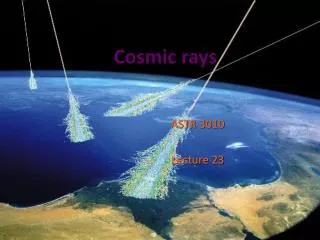
Cosmic rays are high-energy charged particles that primarily consist of protons (86%). Outside the Earth’s atmosphere, these primary rays collide with air molecules at altitudes of about 15 km, resulting in showers of secondary particles, with muons being the most prevalent by the time they reach sea level, detectable at roughly 1 particle per cm² per minute. While most cosmic rays originate from within the solar system, some are extragalactic. Their energy spectrum is a mystery, particularly for the highest energy levels. This overview delves into the nature, origin, and impact of cosmic rays.

Understanding Cosmic Rays: Origin, Interaction, and Characteristics
E N D
Presentation Transcript
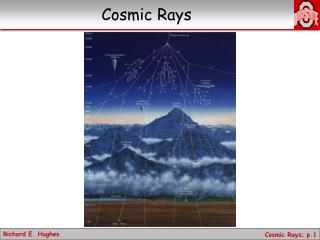
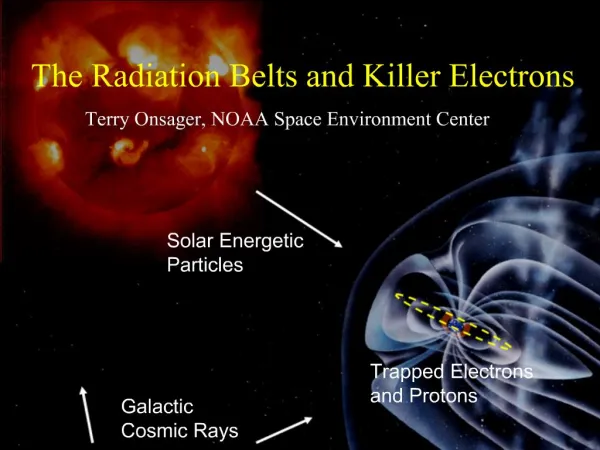
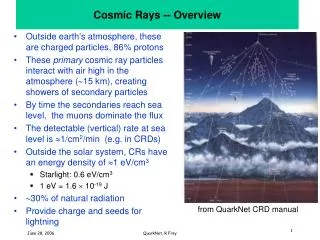
Cosmic Rays -- Overview • Outside earth’s atmosphere, these are charged particles, 86% protons • These primary cosmic ray particles interact with air high in the atmosphere (15 km), creating showers of secondary particles • By time the secondaries reach sea level, the muons dominate the flux • The detectable (vertical) rate at sea level is 1/cm2/min (e.g. in CRDs) • Outside the solar system, CRs have an energy density of 1 eV/cm3 • Starlight: 0.6 eV/cm3 • 1 eV = 1.6 10-19 J • 30% of natural radiation • Provide charge and seeds for lightning from QuarkNet CRD manual QuarkNet, R Frey
composition of primaries • 90% protons (not anti-protons) • The remainder mostly follow solar system abundances (eg meteorites and solar photosphere) • Spallation of O and C nuclei, for example, create more Li, Be, B than is typical of solar system cosmic rays solar system QuarkNet, R Frey
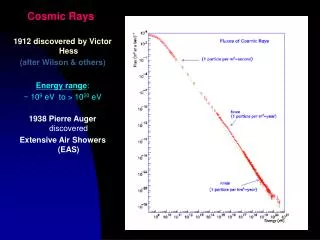
energy and origin of primaries • Steeply falling, power law energy spectrum • For E1014 eV, spectrum and flux are consistent with acceleration by shock waves from supernovae (“Fermi acceleration”) • For larger energy, mechanism is unknown (black hole at galactic center??) • For E1019 eV, protons would not be captured by galactic magnetic field (310-10 T) • So higher energy CRs must be extra-galactic... but GZK cutoff... a mystery
cosmic rays at earth’s surface (secondaries) • Primaries interact at z15 km, producing a shower of (mostly) short-lived particles. • e.g. pion () lifetime is 2.610-8 s • The long-lived secondaries are: • e, photons: mostly absorbed • neutrinos (): practically invisible • muons (): =lifetime is 2.210-6 s • Without time dilation, muons would travel dc=660 m, with a survival fraction e-0.66/15 10-10 • Instead, for a 10 GeV muon, =10/0,1=100, then mean distance is 66 km. (OK) • Detectable (vertical) flux is 1/cm2/min • Simulated event: start...end • Movie • Sim tool