Advances in Automatic Speech Recognition Using Recurrent Neural Networks
This paper explores the innovative application of Recurrent Neural Networks (RNNs) in Automatic Speech Recognition (ASR) systems, emphasizing the critical role of context and statistical probabilities in language processing. It discusses the challenges in distinguishing phonemes and the integration of phoneme and word postprocessing techniques. The study outlines a structured approach to developing an ASR system solely based on Artificial Neural Networks (ANNs), detailing training methods, performance metrics, and conclusions drawn from experiments utilizing the TIMIT Speech Corpus.

Advances in Automatic Speech Recognition Using Recurrent Neural Networks
E N D
Presentation Transcript
Automatic Speech Recognition Using Recurrent Neural Networks Daan Nollen 8 januari 1998 Delft University of Technology Faculty of Information Technology and Systems Knowledge-Based Systems
“Baby’s van 7 maanden onderscheiden al wetten in taalgebruik” • Abstract rules versus statistical probabilities • Example “meter” • Context very important • sentence (grammer) • word (syntax) • phoneme “Er staat 30 graden op de meter” “De breedte van de weg is hier 2 meter”
Contents • Problem definition • Automatic Speech Recognition (ASR) • Recnet ASR • Phoneme postprocessing • Word postprocessing • Conclusions and recommendations • Problem definition
Problem definition:Create an ASR using only ANNs • Study Recnet ASR and train Recogniser • Design and implement an ANN workbench • Design and implement an ANN phoneme postprocessor • Design and implement an ANN word postprocessor
Contents • Problem definition • Automatic Speech Recognition (ASR) • Recnet ASR • Phoneme postprocessing • Word postprocessing • Conclusions and recommendations
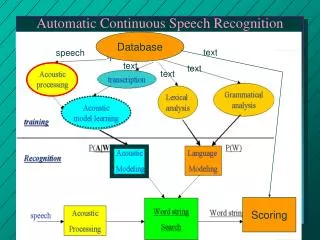
Pre- processing Recognition Post- processing Automatic Speech Recognition (ASR) • ASR contains 4 phases A/D conversion
Contents • Problem definition • Automatic Speech Recognition (ASR) • Recnet ASR • Phoneme postprocessing • Word postprocessing • Conclusions and recommendations
Recnet ASR • TIMIT Speech Corpus US-American samples • Hamming windows 32ms with 16ms overlap • Preprocessor based on Fast Fourier Transformation
Recnet Recogniser • u(t) external input (output preprocessor) • y(t+1) external output (phoneme probabilities) • x(t) internal input • x(t+1) internal output x(0) = 0 x(1) = f( u(0), x(0)) x(2) = f( u(1), x(1)) = f( u(1), f( u(0), x(0)))
Performance Recnet Recogniser • Output Recnet probability vector • 65 % phonemes correctly labelled • Network trained on parallel nCUBE2 /eh/ = 0.1/ih/ = 0.5 /ao/ = 0.3 /ae/ = 0.1
Training Recnet on the nCUBE2 • Per trainingcycle over 78 billion floating point calculations • Training time SUN 144 mhz 700 hours (1 month) • nCUBE2 (32 processors) processing time 70 hours
Contents • Problem definition • Automatic Speech Recognition (ASR) • Recnet ASR • Phoneme postprocessing • Word postprocessing • Conclusions and recommendations
Recnet Postprocessor • Perfect recogniser • Recnet recogniser /h/ /h/ /h/ /eh/ /eh/ /eh /eh/ /l/ /l/ /ow/ /ow /ow/ /h/ /eh/ /l/ /ow/ /h/ /k/ /h/ /eh/ /ah/ /eh /eh/ /l/ /l/ /ow/ /ow /h/
Hidden Markov Models (HMMs) p(a)=pa2 p(b)=pb2 p(n)=pn2 p(a)=pa1 p(b)=pb1 p(n)=pn1 • Model stochastic processes • Maximum a posteriori state sequence determined by • Most likely path by Viterbi algorithm a11 a22 a12 S1 S2 a21
Recnet Postprocessing HMM p(/eh/)=y/eh/ p(/ih/)=y/ih/ p(/ao/)=y/ao/ p(/eh/)=y/eh/ p(/ih/)=y/ih/ p(/ao/)=y/ao/ • Phonemes represented by 62 states • Transitions trained on correct TIMIT labels • Output Recnet phoneme recogniser determines output probabilities • Very suitable for smoothing task a11 a22 a12 /eh/ /ih/ a21
Scoring a Postprocessor • Number of frames fixed, but number of phonemes not • Three types of errors - insertion /a/ /c/ /b/ /b/ /a/ /c/ /b/- deletion /a/ /a/ /a/ /a/ /a/ ...- substitution /a/ /a/ /c/ /c/ /a/ /c/ • Optimal allignment /a/ /a/ /b/ /b/ /a/ /b/ /a/ /c/ /b/ /b/ /a/ /c/ /b/
Scoring Recnet Postprocessing HMM • No postprocessing vs Recnet HMM • Removing repetitions • Applying scoring algorithm
Elman RNN Phoneme Postprocessor(1) • Context helps to smooth the signal • Probability vectors input • Most likely phoneme output
RNN Phoneme Postprocessor(2) • Calculates conditional probability • Probability changes through time
Training RNN Phoneme Postprocessor(1) • Highest probability determines region • 35 % in incorrect region • Training dilemma: • Perfect data, context not used • Output Recnet, 35 % errors in trainingdata • Mixing trainingset needed
Training RNN Phoneme Postprocessor(2) • Two mixing methods applied • I : Trainingset = norm( Recnet + (1- ) Perfect prob) • II: Trainingset = norm(Recnet with p(phncorrect)=1)
Conclusion RNN Phoneme Postprocessor • Reduces 50% insertion errors • Unfair competition with HMM • Elman RNN uses previous frames (context) • HMM uses preceding and successive frames
Example HMM Postprocessing a=1 b=0 Frame 1: p(/a/)=0.1 p(/b/)=0.9 0.8 0.8 p(/a/, /a/) = 1·0.8·0.1 = 0.08 p(/a/, /b/) = 1·0.2·0.9 = 0.18 0.2 Frame 2: p(/a/)=0.9 p(/b/)=0.1 /a/ /b/ p(/a/, /a/, /a/) = 0.08·0.8·0.9 = 0.0576 p(/a/, /a/, /b/) = 0.08·0.2·0.1 = 0.0016 p(/a/, /b/, /a/) = 0.18·0.2·0.9 = 0.0324 p(/a/, /b/, /b/) = 0.18·0.8·0.1 = 0.0144 0.2
Conclusion RNN Phoneme Postprocessor • Reduces 50% insertion errors • Unfair competition with HMM • Elman RNN uses previous frames (context) • HMM uses preceding and succeeding frames • PPRNN works real-time
Contents • Problem definition • Automatic Speech Recognition (ASR) • Recnet ASR • Phoneme postprocessing • Word postprocessing • Conclusions and recommendations
Word postprocessing • Output phoneme postprocessor continuous stream of phonemes • Segmentation needed to convert phonemes into words • Elman Phoneme Prediction RNN (PPRNN) can segment stream and correct errors
Elman Phoneme Prediction RNN (PPRNN) • Network trained to predict next phoneme in coninuous stream • Squared error Sedetermined by
Testing PPRNN“hh iy - hv ae dcl - p l ah n jh dcl d - ih n tcl t ix - dh ix - dcl d aa r kcl k - w uh dcl d z - bcl b iy aa n dcl d”
Performance PPRNN parser • Two error types • insertion error helloworld he-llo-world • deletion error helloworld helloworld • Performance parser complete testset • parsing errors : 22.9 %
Error detection using PPRNN • Prediction forms vector in phoneme space • Squared error to closest cornerpoint squared error to most likely Se mostlikely • Error indicated by
Phnml(x+1) Phnml(x+2) Error correction using PPRNN Phn(x) Phn(x+1) Phn(x+1) • Insertion error Phn(x+2) • Deletion error • Substitution error
Performance Correction PPRNN • Error rate reduced 8.6 %
Contents • Problem definition • Automatic Speech Recognition (ASR) • Recnet ASR • Phoneme postprocessing • Word postprocessing • Conclusions and recommendations
ConclusionsPossible to create an ANN ASR • Recnet • documented and trained • Implementation RecBench • ANN phoneme postprocessor • Promising performance • ANN word postprocessor • Parsing 80 % correct • Reducing error rate 9 %
Recommendations • ANN phoneme postprocessor • different mixing techniques • Increase framerate • More advanced scoring algorithm • ANN word postprocessor • Results of increase in vocabulary • Phoneme to Word conversion • Autoassociative ANN • Hybrid Time Delay ANN/ RNN
A/D Conversion • Sampling the signal 1000101001001100010010101100010010111011110110101101 Hello world
Preprocessing • Spliting signal into frames • Extracting features 1000101001001100010010101100010010111011110110101101 101101 010110 111101 111100
Recognition • Classification of frames 101101 010110 111101 111100 101101 010110 111101 111100 H E L L
Postprocessing • Reconstruction of the signal 101101 010110 111101 111100 “Hello world” H E L L
Training Recnet on the nCUBE2 • Training RNN computational intensive • Trained using Back- propagation Through Time • nCUBE2 hypercube architecture • 32 processors used during training 0 1 2 3
Training results nCUBE2 • Training time on nCUBE2 50 hours • Performance trained Recnet 65.0 % correct classified phonemes
Viterbi algorithm • A posteriori most likely path • Recursive algorithm with O(t) is the observation SN ... S7 S6 S5 S4 S3 S2 S1 0 1 2 3 4 ... T
Elman Character prediction RNN (2) • Trained on words“Many years a boy and girl lived by the sea. They played happily” • During training words picked randomly from vocabulary • During parsing squared errorSe is determined by with yiis correct output of node i and ziis the real output of node i • Seis expected to decrease within a word