Download
1 / 24
240 likes | 354 Vues
This research explores the accuracy of neutrino-nucleus interactions, addressing challenges in validating calculations. The neutrino spectrum is broad, with uncertainties of 10-20%, hindering straightforward interpretation of measured events involving various interactions (quasi-elastic, DIS). We utilize new neutrino scattering data from experiments like MiniBOONE and NOMAD, alongside recent electron scattering data, to assess calculation accuracy. Key developments in theoretical calculations and their implications for various energy regions (10 MeV to 2000 MeV) are discussed, emphasizing the importance of final-state interactions and scaling methods.

E N D
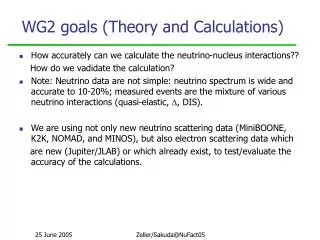
WG2 goals (Theory and Calculations) • How accurately can we calculate the neutrino-nucleus interactions?? How do we vadidate the calculation? • Note: Neutrino data are not simple: neutrino spectrum is wide and accurate to 10-20%; measured events are the mixture of various neutrino interactions (quasi-elastic, D, DIS). • We are using not only new neutrino scattering data (MiniBOONE, K2K, NOMAD, and MINOS), but also electron scattering data which are new (Jupiter/JLAB) or which already exist, to test/evaluate the accuracy of the calculations. Zeller/Sakuda@NuFact05
We need accurate Electron-nucleon scattering data to test and improve Neutrino-nucleon scattering data • Electromagnetic current (Jaem) and weak hadronic charged current (JaCC=Va1+i2–Aa1+i2) are related through CVC: e e q N N Zeller/Sakuda@NuFact05
Developments in Theoretical Calculations • O. Benhar, Comparison of Electron and Neutrino Nucleus Scattering Data with LDA Calculations, hep-ph/0506116 (PRD) • M. Barbaro, Using Electron Scattering Superscaling to Predict Neutrino-Nucleus Scattering, PRC71,015501,2005 • N. Jachowicz, Relativistic Models for Quasi-Elastic Neutrino-Nucleus Scattering, Nucl-th/0505008 • M. Valverde, Inclusive Nucleon Emission Induced by Quasi-Elastic Neutrino-Nucleus Interactions, PRC70, 05503,2004 • A. Botrugno, Neutrino Nucleus Scattering in Giant Resonance Region and in Quasi-Elastic Peak • Y. Sakemi, Study for the Neutrino Coherent Pion Production Experiment ---experimental proposal • A. Kataev, The Relations Between Bjorken Polarized, Bjorken Unpolarized, and Gross-Llewellyn Smith Sum Rules Zeller/Sakuda@NuFact05
Energy region Physics interest 1. 1-100 MeV Reactor, Supernova Nuclear shell structure is important. 2. 100-500 MeV Supernova, ATMn, LSND 3. 500-2000 MeV MiniBOONE, K2K, ATMn, T2K Quasi-elastic and D production are important. 4. E>5 GeV MINOS, CNGS, ATMn Nulcear effects in DIS Zeller/Sakuda@NuFact05
Achievements Zeller/Sakuda@NuFact05
1. Energy region: 500-2000 MeV • Considering correct Fermi momentum distribution is important. P(p,E): 10-20% effect in cross section and spectrum wrt a simple relativistic Fermi-gas model. See NuInt04 Proceedings NPB(Proc)139. • We now consider the final state interaction (FSI). Benhar/Jachowicz/Valvelde try to evalate this effect using nulcear transparency data. Zeller/Sakuda@NuFact05
ds/dn O(e,e’), n=Ee-Ee’=Enegy transfer (GeV)Ee=700-1200 MeV Blue: Fermi-gas Green: SP Red: SP+FSI QE D Zeller/Sakuda@NuFact05
Prediction for ds/dQ2of FG, SP, SP+FSI validated by electron scattering data, Benhar et al., hep-ph/0506116, PRD FG SP SP+FSI Zeller/Sakuda@NuFact05
Validation of FSI effect: Calculated transparency compared to data Transparency= Probability that a nucleon can escape from the nucleus without being subject to any interaction. i.e. T=1.0 = Completely transparent=No interaction Benhar et al., hep-ph/0506116 Jachowicz et al., nucl-th/0505008 Zeller/Sakuda@NuFact05
The effect of FSI (rescattering)-Valverde Zeller/Sakuda@NuFact05
Use scaling to understand/parametrize data better and quantify -Barbaro et al Zeller/Sakuda@NuFact05
D production –Some differences Benhar (Bodek-Ritchie) Valverde Nakamura (Paschos) QE D Zeller/Sakuda@NuFact05
500-2000 MeV • Quasi-elastic interaction • Calculation of neutrino-nucleus quasi-elastic interaction (500-2000MeV) is in good shape. Going from a simple FG to spectral function S(p,E) improves the cross section calculation by 10-20%. • FSI (nuclear rescattering) makes the cross section changes by another 5-10%. • Overall, the calculation is good to 10% level, considering those effect. • D production • There are some differences between the calculations at Delta peak. • Dip region between quasi-elastic and Delta need to be studied. • Valverde’s calculation looks good. 30-40% differences exist between the calculations. We need further checks. Zeller/Sakuda@NuFact05
2. Energy region: 10-500 MeV • Butrogno (CRPA, Lecce) and Valverde (RPA, Granada) seems to reproduce LSND cross sections. • Butrogno (CRPA) can reproduce C(e,e’)C* E=10-50 MeV and O(e,e’) E=300-800 MeV reasonably. Zeller/Sakuda@NuFact05
E Transferred Energy x Continuum Random Phase Approximation +FSI --By Botrugno Collective excitations Zeller/Sakuda@NuFact05
Energy Region: II) Giant Resonance Zeller/Sakuda@NuFact05
Valverde (RPA) Zeller/Sakuda@NuFact05
Energy Region: I) Quasielastic Peak Zeller/Sakuda@NuFact05
3. Coherent pion production • Rein-Seghal calculation is 20 years old. • New calculations (Mateau, Paschos) seem to predict less. • K2K showed a suppressed cross section. • Sakemi (RCNP) performs a new relevant measurement using proton beam and will compare it with the calculation. p + A → n + π+ + A (g.s.) • We need to update the calculations. Zeller/Sakuda@NuFact05
RCNP Coherent Pion Production at RCNP, Osaka g’ΔΔ ~ extract from Coherent Pion Production p + A → n + π+ + A (g.s.) • Peak shift from Delta residual interaction • ΔE ≈ g’ΔΔ(ћcfpND/mp2)ρ0 • Longitudinal response function :RL~ dominant at 0 degree • scpp(0°) → RL → g’ (g’NN, g’ND, g’DD) Light ion induced CPP experiment status : • RCNP 12C(p,nπ+)12C(G.S.)~ in progress Experiment • Beam ~ proton 400MeV un-polarized ⊿E~100keV • Target ~ 12C (100mg/cm2) • Detector • Netron detector ~ ⊿E~300 keV • π detector ~ ⊿E~1 MeV • Identification of CPP • select the ground state of residual nucleus coherent pion cross section[2]. correlation of cross section and g’ΔΔ[3]. [2] E. Oset, Nucl. Phys. A 592 (1995) 472. [3] T. Udagawa et al., Phys. Rev. C 49 (1994) 6. Zeller/Sakuda@NuFact05
4. Plans for the next NuFact06 • 500-2000MeV: D cross section and Dip region should be checked. • 10-500 MeV: Validate CRPA, RPA calculations more. • Calculation of coherent pion production will be examined and more comparison with other data (K2K NC, MiniBOONE) will be done. • Non-resonant and DIS will be examined. • First of all, we ask the theorists to make a calculation usable and open for us experimenters, so that we can use/test it in the experiments. Zeller/Sakuda@NuFact05
The 4th Workshop on Neutrino-Nucleus Interactions In the Few-GeV Region (NuInt05) Okayama University, 26-29 September, 2005 Supported by JSPS (Japan) and CNR (Italy) NuInt04 (Gran Sasso) Nucl.Phys.B(Proc.Suppl.)139. Zeller/Sakuda@NuFact05
Spectral Function for Various Nuclei • Spectral Functions P(p,E) for various nuclei, eg.16O, are estimated by Benhar et al. using e-N data. P(p,E) : Probability of removing a nucleon of momentum p from ground state leaving the residual nucleus with excitation energy E. Fermi momemtum Fermi Gas model p Zeller/Sakuda@NuFact05