Understanding Mendelian Inheritance and Human Traits
260 likes | 387 Vues
This overview explores Mendelian inheritance, emphasizing the distinctions between homozygous dominant, homozygous recessive, and heterozygous phenotypes. It explains concepts such as intermediate inheritance and codominance, illustrated with examples like red, white, and pink flowers, as well as sickle cell anemia. The genetics of blood types is also detailed, highlighting multiple alleles. The use of pedigrees to trace traits in families is included, showcasing inheritance patterns and predicting genotypes for traits like attached and free earlobes, along with a brief discussion on recessive and dominant disorders.


Understanding Mendelian Inheritance and Human Traits
E N D
Presentation Transcript
Mendelian Inheritance • Heterozygous and Homozygous Dominant have the same phenotype • Homozygous recessive will have a different phenotype
Intermediate Inheritance (Incomplete Inheritance) • The heterozygote is an intermediate of the two homozygotes • Red (RR) X White (WW) • Pink (RW) RR WW RW
Pink Flower Ex. • RR - Red • WW - White • RW - Pink • All Offspring are pink R R W W
Pink Flower Ex.(cont.) • RR - Red • WW - White • RW - Pink • 1/4 = Red • 1/2 = Pink • 1/4 = White R W R W
Codominance • Sickle Cell Anemia • Blood cells are shaped like a sickle or half-moon • The sickled cells cause clots • Heterozygotes have some normal and some sickled cells • SS = Sickeled cells • RR = Regular cells • SR = Some regular, some sickled S S R R
Sometimes there are more than two alleles for each trait Ex. Blood types A B O AB The alleles: A = IA B = IB O = i Multiple Alleles
Multiple Alleles (cont.) • Blood type is determined by the surface proteins on a blood cell • Proteins are determined by what alleles the person has
Multiple Alleles (cont.) A AB B O
Multiple Alleles (cont.) IA i • Can a man with type A blood and a woman with type AB blood have a daughter with type B blood? IA IA IA IB IA IB
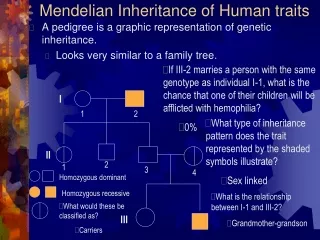
Pedigrees • A family tree that records and traces traits in a family
Gender • Gender • Males = Squares • Females = Circles • Relationship • A line connecting = marriage
Relationships • Vertical lines = parents to children • Each row = one generation • Roman numerals (I,II,III, etc.) • Individuals (1,2,3,4, etc.) • Slash = death
Phenotype • Shaded circle of square = A person who has the trait being studied • Unshaded = Does not have trait • Half-shaded = carrier or heterozygote
Answers Parents I 2 1 II Children/Siblings 2 1 3 Death
Used to determine genotype Shaded = attached earlobes (recessive trait) Label the genotypes! F = free earlobes, f = attached earlobes
Ff Ff Ff Ff F? ff F ? Ff F ? Used to determine genotype Shaded = attached earlobes (recessive trait) Label the genotypes! F = free earlobes, f = attached earlobes
Ff Ff Ff Ff F? ff F ? Ff F ? Can predict offspring Genotype • What is the percent chance that the next child in generation III will have attached earlobes?
Use a Punnett Square F f 25% chance for attached earlobes F f
Diseases caused by recessive alleles • Cystic Fibrosis • Defect in cell membrane protein • Develop a thick mucus in lungs and digestive tract • Tay-Sachs • No enzyme that breaks down lipids • Lipids build up nervous tissue => Brain damage • Phenylketonuria (PKU) • No enzyme to change phenylalanine into tyrosine • Build up of phenylalanine => Brain Damage
Dominant Allele diseases • Huntington’s Disease • Braek down of brain tissue • Achondroplasia • A form of dwarfism • Some forms of blindness
Dominant Disorders • Most of the diseases caused by dominant alleles are lethal in Heterozygotes • The individuals die before they can reproduce • Low frequency of these alleles (<99.99%)
Recessive Disorders • Recessive alleles are not lethal in heterozygotes • Will be passed on from generation to generation • Only homozygous recessive individuals are affected.