Air Masses, Fronts, and Lows in Weather Systems
Learn about air masses, fronts, and low-pressure systems in meteorology, including characteristics of different air masses and types of fronts. Discover how fronts influence temperature, wind direction, humidity, and precipitation in weather patterns.

Air Masses, Fronts, and Lows in Weather Systems
E N D
Presentation Transcript
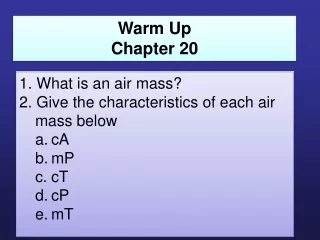
Warm Up Chapter 20 • 1. What is an air mass? • 2. Give the characteristics of each air mass below • cA • mP • cT • cP • mT
20.2: Fronts and Lows • Section 20.2 - Agenda • What is a Front? • Types of Fronts • Warm • Cold • Stationary • Occluded • Life cycle of a Mid-Latitude Low
What is a Front? • The boundary that separates different air masses. • Usually bring: • Changes in Temperature • Changes in Wind Direction • Changes in Humidity • Precipitation
Warm Air Cold
1. Cold Front • Advancing Cold Air • Forces Warm air up at a Steep slope • Usually a narrow band of precipitation • Cumulonimbus Clouds
2. Warm Front • Advancing Warm Air • Warm air rides over cold air at a low slope • Usually a wide band of precipitation • Brings thinner, layered clouds
Warm Air Cold Air Vis 2002
3. Occluded Front • Cold Front catches up to Warm Front since cold fronts move twice as fast. • Warm air is squeezed up, forming clouds.
4. Stationary Front • Front is Not Moving. • Warm air still rises above cold air, bringing clouds and precipitation. • Can lead to flooding.
Life Cycle of a Mid-Latitude Low • Fronts are usually connected to Low Pressure systems. • As the Low spins, the fronts move and Cold front catches up to Warm.
Upper Air Flow • Upper • Air Flow • steers • the • Low • along
Weather associated with Pressure Systems As a Low moves near, the weather will change. A B C