Understanding Hydrolysis, Dehydration, and Enzyme Activity in Biological Processes
In this lesson, students will explore the concepts of hydrolysis and dehydration reactions, and how enzymes affect activation energy in metabolic processes. The difference between secretion and excretion will also be clarified, particularly in the context of diabetic patients and glucose management. Key activities include comparing prokaryotic and eukaryotic cells through Venn diagrams and examining the effects of different solutions on cell membranes. By the end of the lesson, students will have a better understanding of vital biochemical principles that impact living organisms.

Understanding Hydrolysis, Dehydration, and Enzyme Activity in Biological Processes
E N D
Presentation Transcript
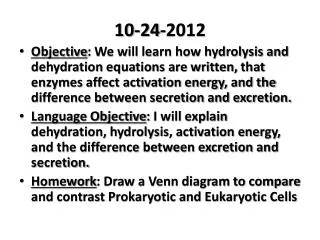
10-24-2012 • Objective: We will learn how hydrolysis and dehydration equations are written, that enzymes affect activation energy, and the difference between secretion and excretion. • Language Objective: I will explain dehydration, hydrolysis, activation energy, and the difference between excretion and secretion. • Homework: Draw a Venn diagram to compare and contrast Prokaryotic and Eukaryotic Cells
Warm-Up • 1. How do amoebas move? False feet (psuedopods) • 2. What is the function of cilia? To aid in movement/locomotion • 3. What is the function of flagella? To aid in movement/locomotion • 4. Cells use passive and active transport to move materials across the cell membrane to maintain _____________________. • a. Diffusionb. evolution c. homeostasis d. respiration • 5. What type of solution was the egg on left placed in? • a. Hypertonic • b. Hypotonic • c. Isotonic
Hydrolysis/Dehydration Hydrolysis or Dehydration?
Hydrolysis/Dehydration Hydrolysis or Dehydration?
Hydrolysis/Dehydration • Hydrolysis – adding water to a reaction • Dehydration – removing water from a reaction
Enzymes – lower activation energy(SPEED UP A CHEMICAL REACTION)
Benedict’s Solution • The most common use for Benedict Solution is the detection of glucose in urine for the diagnosis of diabetes.
Excretion/Absorption/Secretion • Diabetics excrete glucose into their urine because they are unable to properly absorb it into their cells. After a positive diagnosis, additional tests are needed to quantify the amount of glucose excreted. • Excrete – it exits your body • Secretion – released within an organism (hormones) • Sugar = Glucose = Carbohydrate
Excretion/Absorption/Secretion • Osmosis • Diffusion • Dehydration • Hydrolysis • Homeostasis • Enzymes • Hypotonic • Hypertonic DNA RNA Nucleotide (3 parts) Carbohydrates Centromere Centrioles Mitosis S Phase –Synthesis of DNA Cell Cycle Lytic Cycle (viruses) Bacteria Living organisms Cell membrane Prokaryote Eukaryote