
Risk and Return
E N D
Presentation Transcript
Learning goals • 1. Understand the meaning of risk and return • 2. Understand the portfolio diversification • 3. Usage of CAPM and SML
Risk 1 • Task of financial manager: • Assess of risk and return to maximize • Investors, shareholders: • Assess of risk and return to make investment decisions
Risk 2 • Risk definitions: • - classic risk – risk of damage • The chance of financial loss - insurance • - modern – uncertainty • The variability of returns associated with a given asset • - difference between expected and real result : • T- bill? Corporate bonds? Corporate stocks?
Return 1 • Definition: the total gain or experienced on an investment over a given period of time • To measure stock required return: • r = [DIV1 + (P1 –P0) ] / P0
Rate of Return • Example: • Investment cashflow begining end of period • A -100 800 1,100 • B 15,000 120,000 118,000 • C 7,000 48,000 48,000 • r = ?
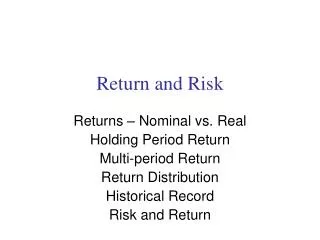
Historical returns for selected security 1926 – 2000 (%) • Type of sec. Nom. Return real return premium on T-bills • Small Stocks 17.7 14.5 13.9 • Large Stocks 13.0 9.8 9.2 • Corp. Bonds 6.1 2.9 2.3 • T-bonds 5.6 2.4 1.8 • T-Bills 3.8 0.6 0.0 • Source: Ibbotson Associetes, Stocks, Bonds and Inflation • * inflation averaged 3.2% over this period
Historical returns • WHERE TO FIND DATA? • Historical returns (up to 50 years) from T. Rowe Price. • Juggling the risk in Forbes. • Chapter 1 of William Goetzmann's"An Introduction to Investment Theory" has a table of Ibbotson data (near the bottom of the page). • Dr. Ed Yardeni's Economics Network has an excellent supply of publications in Adobe Acrobat format. • Global Financial Data from Bryan Taylor II, Ph.D. • Asset Strategy Consulting'sCapital Markets with returns data for the past 20 years. • History, as written by the winners in Forbes (6/16/97). • Professor Robert J. Shiller'sAnnual Data on the US Stock Market: Prices, Dividends, Earnings, 1871-present. • Financial Data Finder from Ohio State University's Department of Finance. • Morgan Stanley and Salomon Brothers among others maintain extensive historical data for asset classes.
Risk preferences 1 • Human behaviours to risks: • Risk - averse • ( need more return to take more risk) • Risk – seeking • (enjoy risk , taking risk , give up some return) • Risk indifferent ( nonsense )
Risk preferences 2 • Investors attitudes to risks: • Hedger • Risk taker • A) speculators ( for risk premiums) • B) hazard (0 premium ) • Arbitrageur
Risk of a single asset • Probability distribution • Chance to occur a given outcome • (80% probability?) • Types: • Bar chart • Continuous distribution • See : www.riskgrades.com
Risk measurement • Measures of risk: • Standard deviation: • Variance: 2
Risk of a portfolio • Diversification or single investment? • Portfolio theory • Total risk = market risk + unique risk • Unique = unsystematic risk , diversifiable • Risk specific to a firm • Market = systematic, non-diversifiable risk, effect all firms
CAPM: the Capital Asset Pricing Model • Equation: • r = rf + ß X ( rm – rf ) • r = free risk return + market premium
Problems • Efficient market? • Betas rely on past varies in time • CAPM in 60’s and now • VAR?
Example • Currently under consideration is a project with a beta of 1.50. At this time the risk free rate of return 7%, and the return on the market portfolio of assets is 10%. The project is actually expected to earn an annual rate of return of 11%. • A. If the return on the market portfolio were to increase by 10%, what would you expect to happen to the project’s required return ?
Example cont. • B. Use the capital asset pricing model to find the required return on this investment. • C. On the basis of your calculation in part b, would you recommend this investment?
www.riskgrades.com • (MSFT) Microsoft Corp (05/01/2007) • RiskGrade: 95 Min: 59 Max: 103 Avg: 79 • Add benchmarks to chart:Investment RiskRanking In other words 78% of the tickers in US Markets are riskier than MSFT. • Minimum RiskGrade in US Markets: 10Maximum RiskGrade in US Markets: 16278Average RiskGrade in US Markets: 211
Learning goals • 1. Understand the meaning of risk and return • 2. Understand the portfolio diversification • 3. Usage of CAPM and SML