Download
1 / 6
60 likes | 207 Vues
This essay investigates the assertion that "knowledge is nothing more than the systematic organization of facts," focusing on the distinction between knowledge and mere facts. It defines key terms, emphasizing the roles of systematic organization in the areas of knowledge, particularly in Natural Sciences and Ethics. For Natural Sciences, it highlights how scientific theories are constructed from facts, illustrated by examples like Special Relativity and Chemistry. In Ethics, it counters with the argument that ethical knowledge varies across cultures, challenging the idea of a systematic organization in morality.

E N D
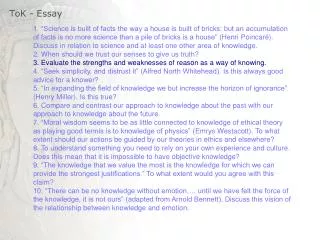
TOK Essay Prompt “Knowledge is nothing more than the systematic organisation of facts.” -Knowledge or Fact- Knowledge is not merely fact but anything further derived from it.
“Knowledge is nothing more than the systematic organisation of facts.” How to Tackle: Define the key terms in the prompt Knowledge vs Fact Systematic organization Connect the prompt with the Areas of Knowledge Example: Natural Sciences and Ethics Find a knowledge issue for each Give specific examples for each so that it backs up the KI
Area of Knowledge - Natural Sciences In what way does science differentiate itself from mere facts? “Knowledge is nothing more than the systematic organisation of facts.”
Area of Knowledge - Natural Sciences “Knowledge is nothing more than the systematic organisation of facts.” Special Relativity: • Mainly theoretical • Derived from proven facts Chemistry: • Cannot observe molecules • Facts come together in a way such that we presume our knowledge is true
Area of Knowledge - Ethics “Knowledge is nothing more than the systematic organisation of facts.” Is knowledge through ethics really a 'systematic organisation of facts'? Counterclaim: Why is it that what we each know as 'ethically right' can change from person to person (specifically looking at culture)?
Area of Knowledge - Ethics “Knowledge is nothing more than the systematic organisation of facts.” • Culture: • Depending on your culture, you view things differently. • Morality: • There is no system for deciding on morality.