Protected Mode Architecture
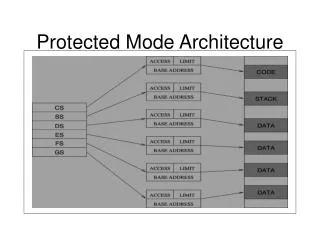
This slide provides an overview of the default segments used in the Protected Mode Architecture of Pentium processors. It highlights the significance of the CS (Code Section) register for instruction fetching and details stack operations involving the SP (Stack Pointer) in 16-bit mode and the ESP (Extended Stack Pointer) in 32-bit mode. Additionally, it explains how data accessing relies on the DS (Data Section) register, with the offset varying according to the addressing mode. This foundational knowledge is crucial for understanding memory management in protected mode.

Protected Mode Architecture
E N D
Presentation Transcript
Default Segments • Pentium uses default segments depending on the purpose of the memory reference • Instruction fetch • CS register (Code Section) • Stack operations • 16-bit mode: SP (Stack Pointer) • 32-bit mode: ESP (Extended Stack Pointer) • Accessing data • DS register (Data Section) • Offset depends on the addressing mode Last slide