
Understanding Equivalents: Decoding Percentage Values and Numerical Equivalents
This document explores various equivalent values expressed in percentages and their numerical forms. It highlights how different percentages relate to their whole numbers and provides clear examples for interpretations. Each entry demonstrates practical scenarios where percentages are utilized, making it easy to grasp financial, academic, or everyday calculations. By analyzing various percentages such as 50%, 20%, 10%, and others, readers will gain insight into converting percentages to their corresponding numerical equivalents.

Understanding Equivalents: Decoding Percentage Values and Numerical Equivalents
E N D
Presentation Transcript
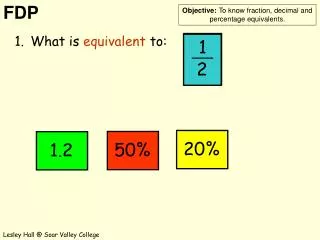
1 1 2 2 50% 1.2 20% 1. What is equivalent to:
1 2 1 10 5 10 0.01 10% 2. What is equivalent to:
2 2 0.2 0.2 2% 10 100 3. What is equivalent to:
1 2 4 5 25% 25% 2.5 4. What is equivalent to:
1 4 0.4 0.4 40% 4% 5. What is equivalent to:
3 3 4 4 0.75 25% 75% 6. What is equivalent to:
1 1 3 3 % 0.3 33 30% 7. What is equivalent to:
1 1 5 5 0.5 20% 5% 8. What is equivalent to:
6 10 0.06 0.06 6% 60% 9. What is equivalent to:
3 6 5 10 0.6 0.6 60% 10. What is equivalent to:
