Download
1 / 6
60 likes | 220 Vues
This overview presents key concepts of saturation and unsaturation in hydrocarbons. Saturated compounds, such as alkanes, contain the maximum number of hydrogen atoms, while unsaturated compounds have double (alkenes) or triple (alkynes) carbon-carbon bonds, altering their structure and properties. Hydrocarbon rings, or cyclic hydrocarbons, exhibit unique characteristics and aren't merely isomers of straight-chain hydrocarbons. Aromatic compounds, notable for their stability and distinct odors, have rings with double bonds and play a significant role in organic chemistry. Learn about these crucial molecules and their applications.

E N D
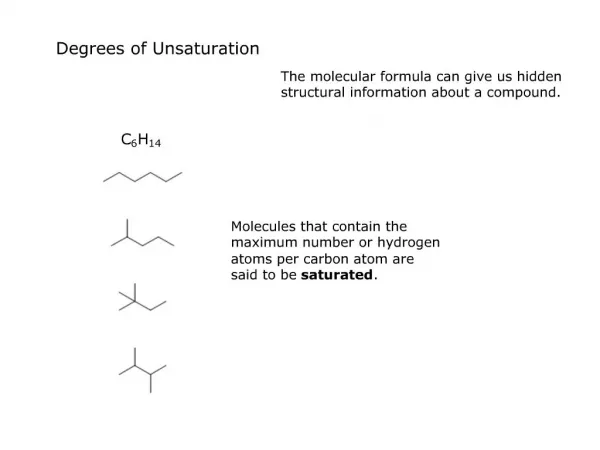
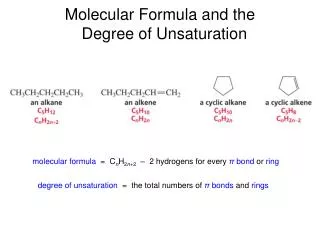
Saturation and Unsaturation • A saturated compound has the maximum number of hydrogen atoms • Alkanes are saturated • Compounds with double and triple bonds are unsaturated compounds
Alkenes • Hydrocarbons that contain AT LEAST one carbon-carbon double covalent bond • Not all the bonds have to be double bonds • Show a double bond using parallel lines • The parent chain must contain the double bond • Name of parent chain ends in “-ene”
Alkynes • Hydrocarbons with AT LEAST one carbon-carbon triple covalent bond • Show with three parallel lines • Other bonds may be single or double bonds • Not very common • Parent chain must contain the triple bond • Name of parent chain ends in “-yne”
Hydrocarbon Rings • The carbon chain can be in the form of a ring • Called a “cyclic hydrocarbon” • They are NOT isomers of the straight chain • (Cyclopentane would not be an isomer of pentane) • Why not? Different molecular formula
Aromatic Compounds • Super stable • Responsible for odors such as vanilla, cinnamon, ginger, etc. • Contain at least one ring or a group of rings with double bonds • Many molecules’ goal is to become aromatic
Benzene • Simplest aromatic compound • Extremely important molecule in organic chemistry • Very stable, but can undergo numerous reactions • Very common structure b/c of its stability • Used widely in industry, found in crude oil • Harmful in large quantities