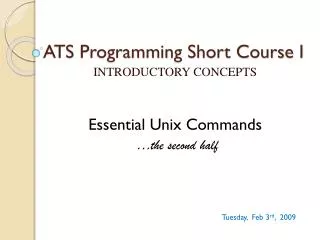
ATS Programming Short Course I
This introductory course provides a solid foundation for individuals with little to no experience in UNIX and scientific computing. Led by instructor Matt Masarik, the course covers key topics including basic programming principles, computing fundamentals, data structures, and network concepts over four weeks. Each week consists of lectures, discussions, and optional office hours to foster understanding and skill development. Students will gain proficiency in UNIX environments and equipped with essential tools for programming and problem-solving.

ATS Programming Short Course I
E N D
Presentation Transcript
ATS Programming Short Course I INTRODUCTORY CONCEPTS Tuesday, Jan. 20th, 2009
PREFACE ASSUMED – Little to no experience with Unix and/or scientific computing GOAL – Establish a foundation to start working in a UNIX environment immediately, and provide the tools and knowledge to quickly gain proficiency. PHILOSOPHY – Provide breadth to (hopefully) illustrate the big picture and interconnection of the different topics covered. Provide the necessary depthin topics most relevant.
PRELIMINARIES Instructor: • Matt Masarik, mmasarik@atmos.colostate.edu Website: • http://www.atmos.colostate.edu/gradprog/programming Class Structure: • 3:00-3:50 - Lecture 1 • 3:50-4:00 - Break • 4:00-4:50 - Lecture 2 • 4:50-5:00 - Summary/Questions • 5:00-5:30 - Office hours [optional]
SYLLABUS WEEK 1 • Lec 1: Introduction to Unix • Lec 2: Programming Basics WEEK 2 • General computing topics – hardware, precision, languages, scripting, programming tools (compiler, text editors, etc.), boolean logic WEEK 3 • Introduction to CS – background, problem solving model, functions, algorithm design, good programming practices, debugging WEEK 4 • Networks & related topics – background, hierarchy, tunneling, vpn, ssh, ftp, scp, http, html/css, security
LAST OF THE DETAILS… • Syllabus vs. Syllabus • Matlab, C • A word about speakers • Student background • Student requests
BASIC PROGRAMMING • Data Structures • constant • scalar • array • exotic • Core Statements/Expressions • declaration/assignment • branches • loops • Operators (relational/logical)
DATA STRUCTURES • Scalar Variables • integer: 3 • float, double: 3.9999 • character: ‘a’ • boolean: True, 1 • string: “jan202009”
DATA STRUCTURES • Constants • By definition do not (should not) change during execution of the program. • Example: Fortran – PARAMETER, any data type (int, float, char). • Example: Matlab – only predefined, pi = 3.14… • Matlab and the declaration global
DATA STRUCTURES • Arrays • multi-dimensional • can be composed of any of the scalar variable types • comment on dimensions (Matlab vs. Fortran)
DATA STRUCTURES • Pointers • a variable that holds the ‘address’ of another variable (any type). It ‘points’ to the location of a variable. • can be ‘dereferrenced’, giving the value of the variable it points to • won’t discuss much
DATA STRUCTURES • Exotic • see example: Linked List of Observation objects
RELATIONAL OPERATORS • Less than • Less than or equal • Greater than • Greater than or equal • Equal • Not equal
LOGICAL OPERATORS • and • or • not • exclusive or (xor)
STATEMENTS / EXPRESSIONS [See Matlab examples] Assignment (declaration/initialization) • Branches • if • case (not here) • Loops • for • while • do while (not here)