Understanding Setting and Point of View in "Two Kinds" by Amy Tan
170 likes | 296 Vues
This lesson focuses on identifying and analyzing the setting and point of view (POV) in Amy Tan's "Two Kinds". Students will explore how the setting influences character development and reader perception through notes, discussions, and video clips. Key activities include examining direct and indirect characterization, understanding Freytag’s Triangle regarding plot structure, and practicing POV through relatable scenarios. By the end of the session, students will gain insights into the narrative techniques used by Tan and reflect on how these elements affect their interpretation of the story.


Understanding Setting and Point of View in "Two Kinds" by Amy Tan
E N D
Presentation Transcript
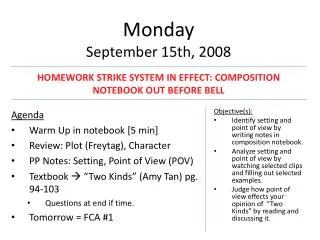
HOMEWORK STRIKE SYSTEM IN EFFECT: COMPOSITION NOTEBOOK OUT BEFORE BELL MondaySeptember 15th, 2008 Objective(s): • Identify setting and point of view by writing notes in composition notebook. • Analyze setting and point of view by watching selected clips and filling out selected examples. • Judge how point of view effects your opinion of “Two Kinds” by reading and discussing it. Agenda Warm Up in notebook [5 min] Review: Plot (Freytag), Character PP Notes: Setting, Point of View (POV) Textbook “Two Kinds” (Amy Tan) pg. 94-103 Questions at end if time. Tomorrow = FCA #1
Warm Up (9/15) [5 min] NO NOTES • Look over your notes on characterization from Thurs/Fri. • What is the difference between DIRECT and INDIRECT characterization? • Read the following sentences. Break down the characters into DIRECT and INDIRECT characterization. YOU DO NOT NEED TO WRITE THE SENTENCES. There is an example below. • EXAMPLE: Mr. Hampton, who was young teacher, carried his books as he walked down the hallway. • DIRECT INDIRECT • young teacher loves teaching • carrying books loves reading • walking down the hallway loves walking • 1: Wherever Bob went, he always wore his grey suit. • 2: That is, until the one day Bob met a strange old man. This old man carried a stack of Bibles with him wherever he went—and oddly enough, had red eyes too.
Freytag’s Triangle (plot) Review NO NOTES
Character NO NOTES • Two ways authors reveal a character: • Direct Characterization • Indirect Characterization
Direct Characterization NO NOTES • The author DIRECTLY tells us the traits of that character.
Characterization NO NOTES • Example: • Bob was a serious person who loved to study. Whenever his friends were playing outside, Bob was in his house, reading books. • What does the author tell us DIRECTLY about Bob?
Indirect Characterization NO NOTES • The author hints at what the character is like—through their clothing, what they carry with them. • Anything and everything can be indirect—even something as small as their eyes. • Allows the reader room for interpretation about a character.
Stock Characters NO NOTES • Stock characters are characters that fit our NATURAL ideas about what a character should look/act/be like. • Remember, THE WIZARD—without me saying anything, 99% of us drew the hat/staff/crystal ball.
Parts of Fiction NO NOTES • Plot • Characters • Setting • Point of View • Theme
Setting TAKE NOTES • Setting is, most simply, where the story takes place. Broadly speaking, setting includes: • Time • Location • Circumstance
Setting NO NOTES • Setting is, most simply, where the story takes place. Broadly speaking, setting includes: • Time (High Noon) • Location (A saloon, the Wild West) • Circumstance (During a gun fight)
Setting Practice NO NOTES • Time (3:20PM) • Location (NMHS Bus Loop) • Circumstance (The school bell has just rung) • PREDICT: What is going to happen?
Setting Practice NO NOTES • Time (Midnight) • Location (A graveyard) • Circumstance (A 15-year old student is sleeping next to a tombstone) • PREDICT: What is going to happen?
POV TAKE NOTES • Point of View (POV) looks at WHO is telling the story. • 1st person: uses “I.” • Example: I walked down the beach until I saw her. • 2nd person: uses “you.” • Example: You walked down the beach until you saw her. • THIS IS VERY RARE IN FICTION. • 3rd person: uses “he/she.” • Example: He walked down the beach until he saw her. • THIS IS THE MOST COMMON
POV TAKE NOTES • The same EVENT can have MULTIPLE points of view. • CLIP “Vantage Point.”
POV Practice NO NOTES • The same EVENT can have MULTIPLE points of view. • A mother and daughter (who is—14 let’s say) argue about the daughter’s boyfriend (who is—18 let’s say) taking her to senior prom. • PUT YOURSELF IN BOTH OF “THEIR SHOES”: • Mother: • Daughter :
Textbook, “Two Kinds, ”pg. 94-103 NO NOTES