
The Eisenhower Years: Election, Domestic Policies, and Foreign Relations
E N D
Presentation Transcript
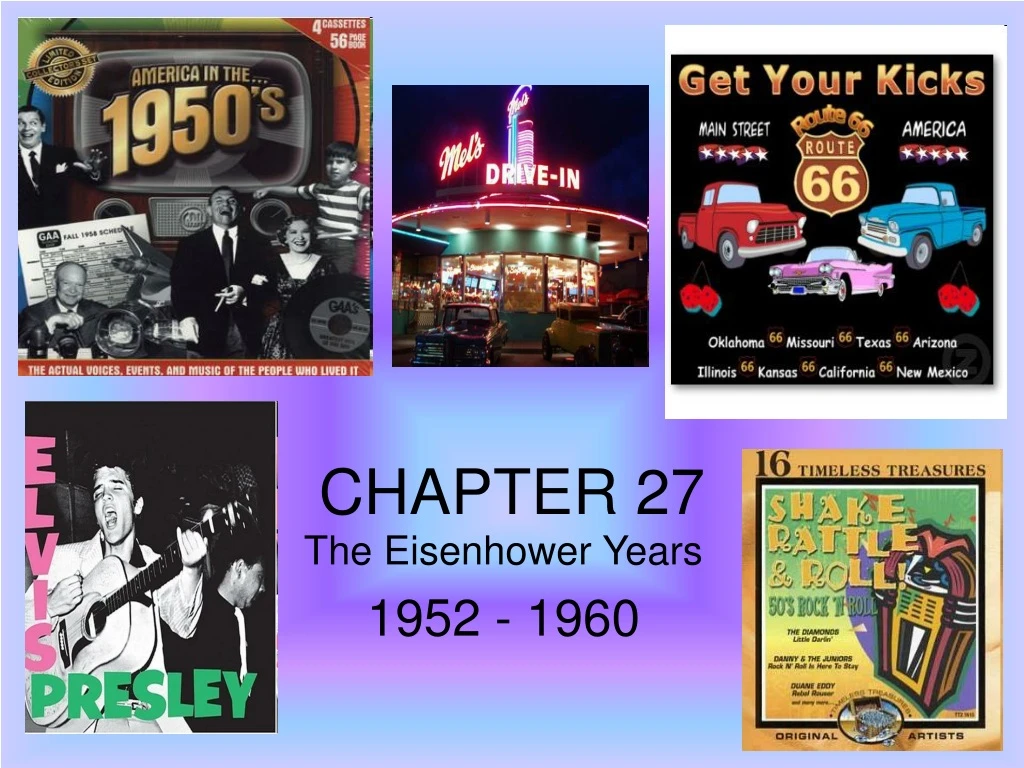
CHAPTER 27 The Eisenhower Years 1952 - 1960
Summarize the election of 1952 • (R) - Eisehnower / Nixon Ticket • (D) - Stevenson / Sparkman Ticket • Eisenhower pledges to end the Korean war if elected. • Ike wins 55% of popular vote & an electoral college landslide of 442 to 89
Domestic Policies of Eisenhower • Goal was to balance the budget • Extended Social Security • Raised minimum wage • Created Dept. of Health, Education & Welfare (cabinet position) • Helped farmers increase their income • Opposed aid to education & federal health care insurance. Bradley, Eisenhower, Patton
Interstate Highway Act (1956) • Construction of 42,000 miles of interstate highways linking major cities • Created jobs • Promoted trucking industry • Suburban growth • Hurt railroad industry
John Foster Dulles • Secretary of State • Thought Truman’s containment policy was too passive. • Wanted the US to challenge the communist nations • US should liberate the nations of Eastern Europe
Brinkmanship • If the US pushed communist nations to the “brink of war”, they would back down. • Eisenhower prevented Dulles from carrying out his ideas
Massive Retaliation • Place greater emphasis on nuclear weapons and air power. • Spend less on the army and navy. • “more bang for the buck”
Why was the US concerned with unrest in the 3rd world? • Lacked political and economic stability • Soviets could make them pawns in the Cold War First (blue), 2nd (Red), Third (green)
Explain Eisenhower’s foreign policy of covert action • Used “undercover” intervention in politics rather than employ troops • Ex. CIA overthrew an Iranian govt. & replaced it with a one that gave the US favorable oil prices.
How did Eisenhower resolve the conflict in Korea? • Armistice & exchange of prisoners in 1953 • US troops withdrawn • Korea remains divided at 38º • No peace treaty ever signed.
At the Geneva conference of 1954, France agreed to give up Indochina, which was divided into the independent states of Cambodia, Laos & Vietnam
North Vietnam • North of 17º parallel • Ho Chi Minh established a communist dictatorship
South Vietnam • Ngo Dinh Diem created an anti-communist government. • US gives $1billion in economic & military aid to build a stable country.
Domino Theory • Analogy by Eisenhower • “If one country fell to communism, one nation after another would also fall”
SEATO • Southeast Asia Treaty Organization • Defense alliance signed by 8 nations to prevent a fall to communism
Eisenhower Doctrine • 1957 • Pledged economic and military aid to any Middle Eastern country threatened by communism • First applied in Lebanon in 1958
OPEC • Oil & Petroleum Exporting Countries • Oligopoly of Arab nations that controlled the middle eastern oil supply
The Spirit of Geneva • The first “thaw” in the cold war (1955) • Slowdown in the arms race • Eisenhower proposed “open skies” - was rejected by the Soviets
How did the US respond to Sputnik? • National Defense & Education Act (NDEA) • gave millions in federal $ to schools for science, math & foreign language ed. • Created NASA
2nd Berlin Crisis • Khrushchev gave the west 6 months to pull troops out of west Berlin • US refused • Ike & Khrushchev meet at Camp David to put off the crisis.
U2 Incident • Russians shot down a US spy plane (U2) over the Soviet Union • Exposed US tactic for getting information • Eisenhower takes responsibility • Khrushchev denounces Ike
Explain how Cuba fell to communism: • Revolutionary Fidel Castro overthrows Batista in 1959. • As a Marxist, he sets up a Communist totalitarian state.
How did Eisenhower respond to the overthrow of Cuba by Castro’s regime? • Eisenhower cuts off all US trade with Cuba.
Describe 2 specific events that became the origin of the Civil Rights Movement • 1. Jackie Robinson becomes the first African American to play on a major league team • 2. Truman integrates the armed forces in 1948
What was the outcome of the Court Case Brown v. BOE – what case did it overturn? • Ended segregation in schools “with all deliberate speed” (Thurgood Marshall) • Overturns Plessy v. Ferguson (separate but equal)
Summarize the incident at Little Rock HS – How did the President Respond? • Governor Faubus used state’s National Guard to prevent 9 African American students from entering LR High School. • Eisenhower orders National Guard to protect the black students as they walked to school.
Rosa Parks • Montgomery, Alabama 1955 • Rosa Parks refuses to give up her seat to a white person • Arrested for violating segregation laws.
Montgomery Bus Boycott • Massive African American protest • Boycott of city buses in Montgomery (381 days) • Nonviolent movement to achieve integration
Role of Martin Luther King Jr. • Emerges as the inspiring leader of “civil disobedience” to achieve integration • Supreme Court rules segregation laws unconstitutional in 1956
What new laws were enacted under the Civil Rights Acts of 1957 & 1969? • Enacted a permanent Civil Rights Commission • Gave the Justice Dept. new powers to protect the voting rights of blacks.
What is a “sit-in” and what were the long-term goals of this form of protest? • Young students would deliberately invite arrest by sitting in restricted areas (ie lunch counters) • Used the non-violent tactic to integrate public facilities