Chemical Formula Writing Rules and Examples
Learn how to write chemical formulas by following specific guidelines. Understand how to handle metals, nonmetals, ions, and polyatomic ions. Get clear examples for better comprehension.


Chemical Formula Writing Rules and Examples
E N D
Presentation Transcript
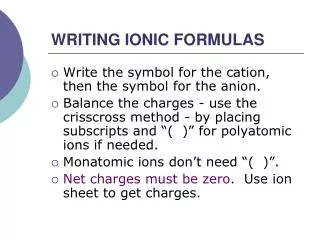
Look at first name • If it is ammonium, put NH4 in parentheses and label it with a charge of +1 • If it is mercury I, put the Hg2 in parentheses and label it with a charge of +2 • If it is a metal, write the symbol with charge labeled. Note, if a roman numeral follows the metal name, that is the charge. • If it is a nonmetal, put its symbol. If there is a prefix, put the corresponding number as a subscript.
Look at second name • If it is a nonmetal, write its symbol with its charge labeled. • If it is a polyatomic anion, put its formula in parentheses and label it with its charge. • If it is a nonmetal, put its symbol. If there is a prefix, put the corresponding number as a subscript. Note, do not put a 1 as a subscript.
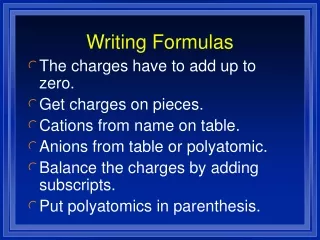
Finalizing • If your name is two nonmetals, you are finished. • If you have charges, crisscross them to get subscripts. • Make sure your subscripts go outside of parentheses • Make sure you reduce the subscripts to their lowest ratio
Hints • You only need to put parentheses around polyatomic ions if there is to be a subscript outside them. However, it is not wrong to always put polyatomics in parentheses. • Na(OH) or NaOH • Ca(OH)2, but not CaOH2 • If the charges balance out, then no subscripts are necessary. • Na+1 NO3-1 becomes simply NaNO3 • Mg+2 and O-2 becomes simply MgO
Examples • Sodium chloride Na+1 Cl -1 NaCl • Sodium nitrate Na+1 (NO3) -1 NaNO3 • Sodium sulfate Na+1 (SO4) -2 Na2SO4 • Ammonium sulfate (NH4)+1 (SO4) -2 (NH4)2(SO4) • Lead II iodide Pb+2 I -1 PbI2 • Lead II nitrate Pb+2 (NO3)-1 Pb(NO3)2 • Lead IV oxide Pb+4 O -2 Pb2O4 PbO2 • Dinitrogen pentoxide N2O5 • Aluminum oxide Al+3 O-2 Al2O3