Download
1 / 2
20 likes | 138 Vues
The GSRC Annual Review discusses key advancements in VLSI design, focusing on calibrating achievable design (C.A.D.). Key themes include optimal memory integration, the benefits of low-k materials, and achievable global signaling quality. The review highlights the importance of industry-compatible, open-source tools and R&D agility through CAD-IP reuse. Moreover, it presents insights into metrics for measuring design success and industry deployment experiences. This comprehensive overview aims to guide future developments in VLSI design and education.

E N D
Calibrating Achievable Design GSRC Annual Review June 9, 2002 Wayne Dai, Andrew Kahng, Tsu-Jae King, Wojciech Maly, Igor Markov, Herman Schmit, Dennis Sylvester
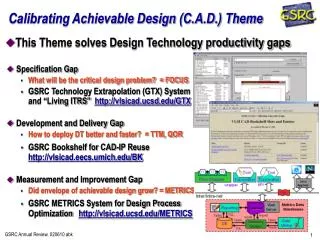
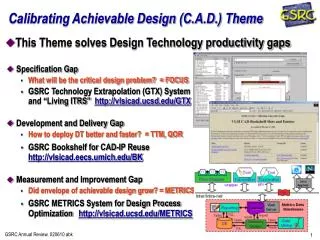
Calibrating Achievable Design (C.A.D.) Theme • GTX / Living Roadmap: Where to Focus? • What is the benefit of low-k? • Achievable global signaling quality? • Optimal memory integration and architecture? • http://vlsicad.ucsd.edu/GTX • CAD-IP Reuse: Faster and Better R&D • Industry-compatible, open-source, back-end flows • Remote execution “autograding” infrastructure • http://vlsicad.eecs.umich.edu/BK • (VLSI design education, common data model, …) • METRICS: Measure & Improve • Survey of design metrics, design project metrics • Clock speed, front-end acceptance, tool noise, … • Industry deployment experience • http://vlsicad.ucsd.edu/METRICS