
Supine Abdominal Radiograph Post Ingestion of Radio-Opaque Markers
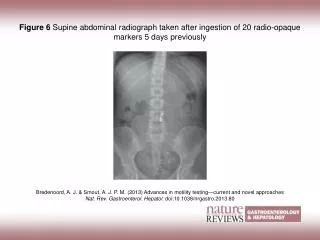
This figure illustrates a supine abdominal radiograph taken five days after the ingestion of 20 radio-opaque markers. The study by Bredenoord and Smout (2013) discusses advances in motility testing, showcasing both current and novel approaches in gastroenterology. The use of radio-opaque markers is explored as a method to assess gastrointestinal transit time and motility, providing valuable insights into digestive disorders. This technique is significant for understanding patient conditions and enhancing diagnostic accuracy.

Supine Abdominal Radiograph Post Ingestion of Radio-Opaque Markers
E N D
Presentation Transcript
Figure 6 Supine abdominal radiograph taken after ingestion of 20 radio-opaque markers 5 days previously Bredenoord, A. J. & Smout, A. J. P. M. (2013) Advances in motility testing—current and novel approaches Nat. Rev. Gastroenterol. Hepatol. doi:10.1038/nrgastro.2013.80