Download
1 / 10
100 likes | 203 Vues
This document provides an extensive overview of the simulated sky data for Checkout 3, comprising 56 days of LAT and GBM burst data. The data includes 47 GRBs, 105 variable AGN, and 17 pulsars, along with isotropically distributed blazars and a dark matter clump. Detailed tables of source locations, flux variability, and spectral indices will be provided. Users can access LAT photon data, pointing history, GBM burst data, pulsar ephemerides, and other resources through the GSSC dataserver. This initiative supports ongoing research in gamma-ray astrophysics.

E N D
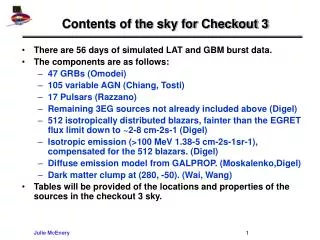
Contents of the sky for Checkout 3 • There are 56 days of simulated LAT and GBM burst data. • The components are as follows: • 47 GRBs (Omodei) • 105 variable AGN (Chiang, Tosti) • 17 Pulsars (Razzano) • Remaining 3EG sources not already included above (Digel) • 512 isotropically distributed blazars, fainter than the EGRET flux limit down to ~2-8 cm-2s-1 (Digel) • Isotropic emission (>100 MeV 1.38-5 cm-2s-1sr-1), compensated for the 512 blazars. (Digel) • Diffuse emission model from GALPROP. (Moskalenko,Digel) • Dark matter clump at (280, -50). (Wai, Wang) • Tables will be provided of the locations and properties of the sources in the checkout 3 sky.
Bright AGN • 105 blazars from high-confidence blazar ids of 3EG sources from Sowards-Emmerd, Romani et al 2003, 2004) + high confidence 3EG blazars. • EBL attenuation using Kneiske model. • Highly variable flux and spectra
Bright AGN - Variability • The 105 bright blazars are modeled with a broken power-law spectrum. • Highly variable flux and spectral slopes. • The values of the flux and spectral indices as a function of time will be provided.
Pulsars • 17 Pulsars: • 6 known EGRET pulsars with parameters as described in Fierro 1999. • 11 pulsars coincident with known EGRET sources. J1745-0952
Dark Matter • 100 GeV Neutralino annihilation, NFW halo profile at l= 280, b= -50. Flux 3x10⁻⁸cm-2s-1.
Orbit and attitude profile • Use the draft DC2 orbit/attitude profile. • T=0 is May 1, 2007. • 90% livetime assumed for all intervals. • Updated LAT definition of the SAA
Pulling it all together The simulated sky Diffuse emission GRB
Accessing the Data • The data will consist of : • LAT photon data (FT1) • pointing and livetime history (FT2) • GBM data for each burst • Pulsar Ephemerides • MC truth • Tables of source locations and properties • AGN lightcurves • Pulsar lightcurves and spectra • The following website http://glast.gsfc.nasa.gov/ssc/dev/databases/STC3 will provide links to the GSSC dataserver, bundled GBM data for each burst and the pulsar ephemerides.
Accessing the data • GSSC dataserver: works very similarly to the one used during DC1. User (optionally) specifies a sky location and radius, time interval and energy interval. • If you enter no time range or cuts, you will be directed to a file containing the entire dataset.