
Pressure Groups
E N D
Presentation Transcript
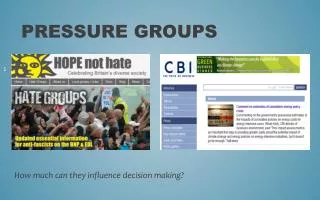
Pressure Groups How much influence do they have?
What are Pressure Groups? • Pressure groups are informal political institutions that seek to influence the making and the implementation of public policy
What do they do? • They cover a broad spectrum from the large business with high level contacts at national and European level to the smallest local group • Can you name any Pressure Groups based on this information?
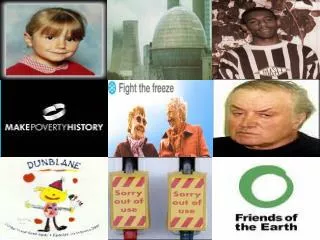
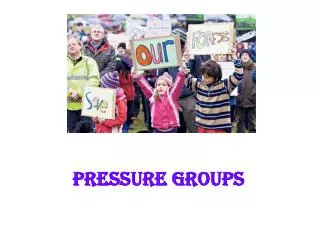
How do they influence? • Secret behind the scenes lobbying of politicians and influential figures • Wynn Transport • Or • Highly visible protests • Fathers for Justice • Make Poverty History
Did you know….. • More people belong to Pressure Groups than political parties? • The study of Pressure Groups and influence is essential in understanding how the system works • Can you think of any ways PG’s are similar or ways they are different to Political parties?
Pressure Groups are different from political parties because • They do not normally contest elections • When they do, they do not aim to form a Government • Their campaigns are based on single issue policies
Pressure Groups are similar to political parties because • They are based on representation and participation • They form a mechanism for the expression of people’s interests • They influence Government and Government policy • Provide funds • Sponsor candidates • Influence the shaping of policies
Types of Pressure Group • Sectional Groups • Based on the performance of an economic function • i.e. CBI, BMA, Law Society, NUT • Cause Groups • Based on shared attitudes and values • i.e. Greenpeace, Amnesty International, Shelter Charter 88 etc.
Insider vs Outsider groups • Insider Groups – Consulted on a regular basis by Government • Outsider Groups – Either do not want to be closely involved or are unable to gain Government recognition
Insider Groups • High Profile – Re-inforce contacts with Government through media contact • Low Profile – Behind the scenes contact with Government • Prisoner Groups – Unable to break free as either dependent on Government or public sector
Outsider Groups • Potential Insider – Groups seeking insider status, a change of Government can change status – i.e. Countryside Alliance • Outsider by necessity – Lack the political skills to succeed • Ideological outsiders – Objectives are at a varaince to social and political norms i.e. CND, ALF etc.
Political Relations with PGs • 1979-1997 Conservative Govts, saw PGs as “Strangling Serpants” – Douglas Hurd • Curtailed TU powers • Won great industrial battles such as 1984 Miners Strike • Professionals groups such as Doctors and Teachers were seen as in need of radical reform therefore influence denied • Independent Schools, Private Health suppliers and housing associations flourished
Blair • The exemption of F1 from tobacco advertising had nothing to do with Bernie Ecclestones £1 million donation • ASH, BMA and several charities were in uproar • Links with the TU’s have weakened, despite Minimum wage and increased public spending on education and health
The Countryside Alliance • My Heroes! • Marched on London in 1998, 2002 and 2004 • Marched against the ban on fox hunting, loss of farmland to urban development, falling incomes, declining rural services • Supported by NFU, Clay Pigeon Assoc, Timber Growers Assoc and the British Field Sports Society
Direct Action • May Day Riots 2002…boo hiss…. • Soap dodgers marching against capitalism and the march of poverty • Marched through City, destroying buildings, such as McDonalds and defacing statues such as Churchill’s • City workers photocopied £50 notes and threw them out the windows to the protestors • Fuel Protestors 2000 – Hooray!.....blockading petrol stations
A new Social Movement • Wider focus than a single issue, national or even global in it’s outlook • No HQ, no staff, just groups linked by the Internet, global, anarchic and chaotic • Environmentalism is an example • Pressure Groups i.e. Greenpeace • Political Parties i.e. The Green Party • Action – Protest and Direct, i.e. Rainbow Warrior • They include a wide variety of ecologists, conservationists, eco-warriors etc..
Iron Triangle of Global Capitalism WTO IMF World Bank Multi nationals McDonald’s Coca-Cola Nike Texaco GAP Microsoft Disney Victims of Social Movements
Core targets for all PG types • The Core Executive • PM, Ministers, Civil Servants • Parliament • Public Opinion • Local Institutions
So do PGs make the UK democratic?YES! • Participation and Political access • Improvement of Government • Information provided affects quality • Pluralism – Freedom of Association • PGs serve as vital links between Govt. and Soc • Assist in the dispersal of political power • Social Progress • New issues to be debated, i.e. environmentalism • Social Cohesion • Safety valve for grievances • Opposition • Expose information, improving accountability
So do PGs make the UK democratic?Errr….No! • Sectionalism and Selfishness • Only favour the well organised • Anti-Parliamentary democracy • Insider groups may not work in public interest • Elitism • Re-inforces existing class and power structure • Pluralistic stagnation • Too many groups, lots of contrasting aims, can immobilise the system • Social disharmony and dislocation • Intensifies feeling of injustice by highlighted groups • Failure of opposition