Impact of Sleep and Exercise on Long-Term Memory Consolidation
This article explores the intricate relationship between sleep, exercise, and their effects on long-term memory consolidation. Drawing from relevant studies, including Walker (2006) and Fisher et al. (2002, 2003), we examine how sleep supports the stabilization and enhancement of memory following practice. The article discusses various factors, including the timing of sleep and the duration of naps, to understand how they influence learning outcomes. Insights into the architecture of sleep and its role in encoding are outlined, providing a comprehensive view of these critical processes.

Impact of Sleep and Exercise on Long-Term Memory Consolidation
E N D
Presentation Transcript
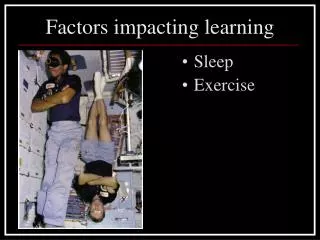
Factors impacting learning • Sleep • Exercise
Long-Term Memory (From Walker, 2006)
Memory Processes From Walker (2006)
Consolidation: Sequence Learning Fisher et al., NATURE, 425, 2003
Consolidation: Is it TIME or SLEEP? Fisher et al., 2002, Proc. Nat. Ac. Sci., 99, 11987-11991
Park, J. & Shea, C.H. (2005). Quarterly Journal of Experimental Psychology, 58, 387-419.
Park, J. & Shea, C.H. (2005). Quarterly Journal of Experimental Psychology, 58, 387-419.
Sleep before practice: Encoding Sleep Deprivation Studies