Understanding Landau Theory: A Comprehensive Overview of Phase Transitions
This document explores the Landau Theory, sharing insights on various approaches to phase transitions. It delves into the molecular field theory by Weiss and microscopic models like the Ising model. Key concepts include effective interaction potentials, order parameters, and broken symmetry, illustrating first and second-order phase transitions. The study discusses critical temperature, thermodynamic properties such as entropy and specific heat, and introduces concepts like the tricritical point. The aim is to offer a unified, phenomenological view of phase transitions across different systems.

Understanding Landau Theory: A Comprehensive Overview of Phase Transitions
E N D
Presentation Transcript
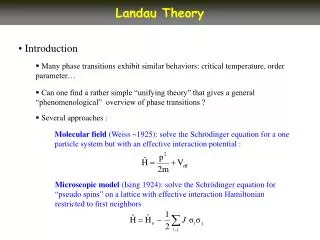
Landau Theory • Several approaches : Molecular field (Weiss ~1925): solve the Schrödinger equation for a one particle system but with an effective interaction potential : • Introduction • Many phase transitions exhibit similar behaviors: critical temperature, order parameter… • Can one find a rather simple “unifying theory” that gives a general “phenomenological” overview of phase transitions ? Microscopic model (Ising 1924): solve the Schrödinger equation for “pseudo spins” on a lattice with effective interaction Hamiltonian restricted to first neighbors
Landau Theory • Introduction • Landau Theory : • Express a thermo dynamical potential as a function of the order parameter (), its conjugated external field (h) and temperature. • Keep close to a stable state minimum of energy power series expansion, eg. like: • Find and discuss minima of versus temperature and external field. • Look at thermodynamics’ properties (latent heat, specific heat, susceptibility, etc.) in order to classify phase transitions
Landau Theory l d x 0 • Broken symmetry • a simple 1D mechanical illustration : • let go with d > lo: equilibrium position (minimum energy) x = 0
Landau Theory l d x 0 xo d dc • Broken symmetry • a simple 1D mechanical illustration : • let go with d < lo: equilibrium position (minimum energy) x = xo0 Order parameter • critical value dc= lo spontaneous symmetry breaking Only irreversible microscopic events will make the system settle at +xo or –xo when the system slowly exchanges energy with external world
Landau Theory l d x 0 • Broken symmetry • a simple 1D mechanical illustration : • Taylor expansion of potential (elastic) energy
Landau Theory l d x 0 Change sign at d=dc !!! Does not change sign • Broken symmetry • a simple 1D mechanical illustration : • Taylor expansion of potential (elastic) energy
Landau Theory h=0 • Second Order Phase Transitions T >>Tc T =Tc T <<Tc =0 stable above Tc , unstable below Tc
Landau Theory T Tc T Tc o T Tc • Second Order Phase Transitions • Stationary solution :
Landau Theory (o) - o T S(o) - S o Tc Tc T • Entropy : • Second Order Phase Transitions T Tc • Free energy : T Tc No Latent Heat: TcS = 0
Landau Theory cp - co T Tc • Second Order Phase Transitions T Tc • Specific heat : T Tc
Landau Theory -1 T Tc T Tc T Tc • Second Order Phase Transitions • Susceptibility : Curie law
Landau Theory T Tc A 0 h T Tc A 0 h • Second Order Phase Transitions • field hysteresis :
Landau Theory • Second Order Phase Transitions SUMMARY • One critical temperature Tc • No discontinuity of , , S (no latent heat) at Tc • Jump of Cp at Tc • Divergence of and at Tc • Field hysteresis
Landau Theory • First Order Phase Transitions: T > T1 : o=0 stable T1 > T > To: o=0 stable o0 metastable To > T > Tc: o=0 metastable o0 stable Tc > T : o 0 stable
Landau Theory equ. T > T1 : o=0 stable T1 > T > To: o=0 stable o0 metastable To > T > Tc: o=0 metastable o0 stable T Tc To T1 Tc > T : o 0 stable • First Order Phase Transitions: Thermal hysteresis
Landau Theory T Tc + T Tc • First Order Phase Transitions: • Steady state :
Landau Theory • First Order Phase Transitions: T = To • Steady state :
Landau Theory A and 2 depend on T ! = 0 • First Order Phase Transitions: • Entropy : T = To
Landau Theory = 0 cp co T1 • First Order Phase Transitions: • Specific heat : T T1
Landau Theory o= stable until T down to To -1 Tc To T1 • First Order Phase Transitions: • Susceptibility :
Landau Theory • First Order Phase Transitions SUMMARY • Existence of metastable phases • Temperature domain (Tc T1) for coexistence of high and low temperature phases • at To (Tc< To < T1) both high and low teperature phases are stable • Temperature hysteresis • Discontinuity of , , S (latent heat), Cp, at Tc
Landau Theory • Tricritical point In the formalism of first order phase transitions, it can happen that B parameter changes sign under the effect of an external field. Then there is a point, which is called tricritical point, where B=0. The Landau expansion then takes the following form: • Equilibrium conditions :
Landau Theory Tc T • Tricritical point • Potential : T>Tc:=0 T>Tc:0
Landau Theory A and 2 depend on T ! S Tc T • Tricritical point • Entropy : T>Tc:=0 T>Tc:0
Landau Theory Cp Tc T • Tricritical point • Specific heat : T>Tc:=0 T>Tc:0
Landau Theory -1 T Tc T Tc • Tricritical point • Susceptibility : T>Tc:=0 T>Tc:0