Understanding Alternative Methods of Dispute Resolution in Civil Cases
120 likes | 253 Vues
Explore the importance of Alternative Dispute Resolution (ADR) for civil disputes. Many cases never reach court due to time, costs, and potential negative impacts on relationships. This article discusses key ADR methods like negotiation, arbitration, and mediation. Negotiation allows parties to communicate directly to reach a mutually acceptable solution. Arbitration involves a neutral third party making decisive rulings. Mediation facilitates dialogue between parties, helping them explore solutions creatively and confidentially. Learn how these methods offer effective, flexible, and less adversarial options for resolving disputes.


Understanding Alternative Methods of Dispute Resolution in Civil Cases
E N D
Presentation Transcript
Most Civil Disputes Never Go To Court • Why? • The Court System Takes Time • More civil cases are being filed. • Courts have limited resources. • Criminal cases take priority over civil cases due to the criminally accused right to a speedy trial under the Sixth Amendment to the U.S. Constitution.
The court system is expensive. • A trial and the preparation leading up to it can generate thousands of dollars in legal fees. • The court system can harm ongoing relationships. • Taking a dispute to court can cause anger and bitterness
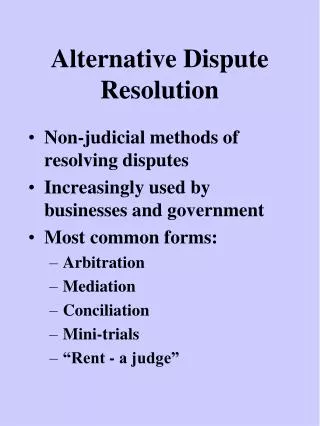
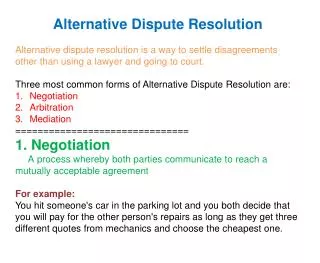
Alternative Dispute Resolution • Negotiation • Arbitration • Mediation
Negotiation • The disputing parties talk to each other about their problem and try to reach a solution that is acceptable to them. • Note: negotiation can be used to settle disagreements ranging from minor disputes between siblings to multi-billion dollar lawsuits between large corporations.
Arbitration • The disputing parties agree to have another person – an arbitrator - listen to their arguments and make a decision for them. • Note: the arbitrator is like a judge, but the process is less formal than a trial. • Arbitrators have the authority to make the final decision and the parties must follow it if it is “binding arbitration.” • If it is “nonbinding arbitration,” the parties are not “bound” and hence do not have to follow the final decision. • Arbitration is common in contract and labor-management disputes. • Many sales and service agreements have an “arbitration clause” requiring “binding arbitration.”
Mediation • A person not involved in the dispute – the mediator - helps the disputing parties talk about their problem and settle their differences.
The Benefits of Mediation • Voluntary • The parties can leave any time. • The parties decide how they want to resolve the dispute. • Mediators do not impose a decision on the parties. • Mediators instead listen carefully to both parties. • Confidential • Mediator cannot be called to testify in court as a witness for a party’s case. • Effective • Allows disputing parties to vent their frustrations. • Avoids placing blame and concentrates on the future relationship between the parties. • Parties are more likely to follow agreement. • Allows parties to come up with creative solutions • Enforceable • If settlement reached and written as legally binding contract • Free • Through many community mediation programs
The Steps of Mediation • Introduction • Telling the story • Identifying positions and underlying interests • Identifying alternative solutions • Revising and discussing solutions • Reaching an agreement
Mediation Role Play • Mediator • Sam • Chris