Vectors
80 likes | 210 Vues
This guide explores the principles of vector addition using the parallelogram method, highlighting the commutative property of vectors. It demonstrates how to break down vectors into components and apply the equations of motion for an arrow shot at a specified angle and speed. By analyzing initial conditions and calculating resultant velocities, we derive the velocity after a set time. Key concepts like vector magnitude, direction, and the effect of gravity on motion are discussed, supported by practical examples and calculations.


Vectors
E N D
Presentation Transcript
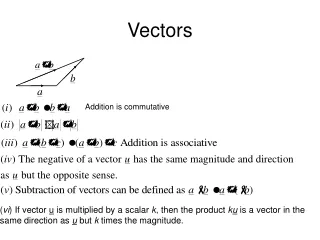
Adding Vectors Parallelogram Method Head to Tail A+B=B+AVector Addition Commutes
Components AddA + B = R ⃗ ⃗ ⃗ Chap 3:10
Our Equations are Vector Equations • vavg = (v1 + v2) / 2 • To multiply or divide a vector by a number • Multiply or divide the magnitude • Leave the direction the same
Acceleration • An arrow is shot with an intial speed of 60 m/sec at an angle of 60° with the horizontal. After 4 seconds how fast is it going? • v2 = v1 + gt • Scale 10m/sec = 1cm • t = 4 s • g = 10m/s2 down • gt = 10m/s2 ∙ 4s = 40m/sdown
Components • v2 = v1 + at • v1 = 60 m/sec 60° N of E • Horizontal = v1x = v1 ∙ cos 60° = 30 m/s • Vertical = v1y = v1 ∙ sin 60° = 52 m/s • a= g = 10 m/s2 down • Horizontal = ax =0 Vertical = ay = −10 m/s2 • at = 10m/s2 ∙ 4s • Horizontal = axt=0 Vertical = ayt= −40 m/s
To Add, Add Components horizvert v1 v1x = v1∙cos60° v1y=v1∙sin 60° 30 m/s 52 m/s at axt=0 ayt= −40 m/s v2=v1+at 30 m/s 12m/s Magnitude = v2 = √(302 +122) = √1044 = 32.3m/s Direction of v2 tan θ =v2y/v2x = 12/30= .4 θ=tan-1 .4 = 21.8°