Download
1 / 13
0 likes | 2 Vues
What is an e-commerce backend? A simple guide for founders on e-commerce backend development, architecture, APIs, integrations, and building scalable online stores.<br><br>This plain-English guide explains how an e-commerce backend works, covering databases, servers, payment gateways, inventory and order management, security, performance tuning, microservices, and headless commerce approaches. Learn practical steps for planning, choosing a tech stack, API design, integrations (payments, shipping, analytics), team roles, and cost considerations u2014 essential for founders who want to build e-commerce...

E N D
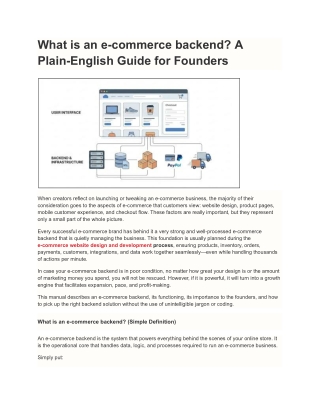
What is an e-commerce backend? A Plain-English Guide for Founders When creators reflect on launching or tweaking an e-commerce business, the majority of their consideration goes to the aspects of e-commerce that customers view: website design, product pages, mobile customer experience, and checkout flow. These factors are really important, but they represent only a small part of the whole picture. Every successful e-commerce brand has behind it a very strong and well-processed e-commerce backend that is quietly managing the business. This foundation is usually planned during the e-commerce website design and development process, ensuring products, inventory, orders, payments, customers, integrations, and data work together seamlessly—even while handling thousands of actions per minute. In case your e-commerce backend is in poor condition, no matter how great your design is or the amount of marketing money you spend, you will not be rescued. However, if it is powerful, it will turn into a growth engine that facilitates expansion, pace, and profit-making. This manual describes an e-commerce backend, its functioning, its importance to the founders, and how to pick up the right backend solution without the use of unintelligible jargon or coding. What is an e-commerce backend? (Simple Definition) An e-commerce backend is the system that powers everything behind the scenes of your online store. It is the operational core that handles data, logic, and processes required to run an e-commerce business. Simply put:
Where the frontend is your internet store, the backend is your stockroom, the financial department, the customer service, and the operations team all rolled into one—automated and working non-stop. Customers are not allowed to see the backend directly, but all their actions—like checking a product, ordering, paying, or following delivery—are absolutely dependent on the backend being in perfect working order. Why Founders Should Care About the E-commerce Backend Many of the e-commerce issues that are blamed on "quality of traffic," "marketing," or "UX" actually turn out to be backend problems introduced during poor e-commerce website design and development. The list of things that a weak backend might be able to cause includes: ● Slow page loads during traffic spikes ● Inventory mismatches and overselling ● Failed payments and abandoned checkouts ● Manual operational work that doesn’t scale ● Poor reporting and unclear business decisions By contrast, a robust backend can: ● Enables faster customer experiences ● Supports growth without chaos ● Reduces operational costs through automation ● Makes data-driven decisions possible ● Future-proofs your ecommerce business To founders, the backend is not a mere technical intricacy but rather a business asset. What Does an E-commerce Backend Actually Do? An e-commerce backend is a system that supports the business with the most essential core functions. Let us take the examples and explain them in simple terms.
1. Product & Inventory Management This is the part where your product data is stored and managed. The backend: ● Stores product names, descriptions, prices, images, and variants ● Manages SKUs, categories, and collections ● Tracks inventory levels in real time Founders, this is important to you, because: ● Incorrect inventory data leads to overselling and refunds ● Poor product data management slows merchandising ● Scaling to thousands of SKUs becomes painful without structure A modern e-commerce backend guarantees that stock will be updated accurately not only on your website but also on marketplaces, in warehouses, and in physical stores. 2. Order Processing & Fulfillment On each occasion when a client clicks "Buy Now," the backend is activated immediately. It: ● Creates the order record ● Validates inventory availability ● Calculates totals, discounts, and taxes ● Triggers fulfillment workflows ● Updates order status in real time The backend additionally has the command over: ● Shipping and delivery tracking ● Returns and refunds ● Partial shipments and backorders Efficient order processing that is efficient is equal to fewer customer complaints, lower overhead expenses, and scaling that is smooth even in peak seasons, which is a good thing for founders. 3. Payments, Taxes & Invoicing Without a doubt, handling the payments is the most delicate part of the backend.
The e-commerce backend: ● Integrates with payment gateways ● Validates transactions and prevents fraud ● Applies taxes based on location and rules ● Generates invoices and payment records This is the place where compliance is of utmost importance. Incorrect backend implementation may lead to: ● Failed payments ● Incorrect tax calculations ● Legal and regulatory risks In short, a strong backend makes a payment system that is secure, reliable, and can be checked for correctness. 4. Customer & Account Management The backend is an employee who handles customer data and relationships. It keeps in store: ● Customer profiles and addresses ● Order history and preferences ● Login credentials and permissions Moreover, it is the source of power for: ● Loyalty programs ● Subscriptions and repeat orders ● Personalized pricing and offers To founders, such data is a goldmine. It is the fuel for retention, personalization, and customer lifetime value. 5. Security, Compliance & Data Protection Ecommerce security should not be considered as an option; rather, it is the basis. The backend performs the security functions of: ● User authentication and authorization ● Encrypting sensitive data
● Protecting against fraud and attacks ● Meeting compliance standards like PCI-DSS and GDPR A backend that is not well-secured can become the reason for trust, which drops dramatically overnight. A safe backend is shielding not only customers but also the business. E-commerce Backend vs Frontend: What’s the Difference? Better comprehension of the difference between frontend and backend will lead to better decisions taken by the founders. Frontend: ● What users see and interact with ● Website design, UI, UX, and animations ● Product pages, cart, and checkout visuals Backend: ● Business logic and data processing ● Inventory, orders, payments, customers ● Integrations with third-party systems
Key insight for founders: An efficient and user-friendly frontend can only operate so well when the backend is equally efficient and well-organized—something experienced e-commerce website design and development services prioritize. Frontend performance is limited by backend performance. Core Components of an E-commerce Backend (Without Jargon) Backends may seem complicated, but they are constructed from understandable parts. Database: The Source of Truth The database is a place where all the main business data is stored: ● Products ● Customers ● Orders ● Inventory What is more: ● Site speed ● Reporting accuracy ● Scalability
A badly thought-out database will slow the business down as it expands. APIs: The Connectors APIs are the tools which allow different technological systems to interact. They make it possible: ● The frontend to fetch product data ● Mobile apps to place orders ● Payment gateways to confirm transactions ● CRMs and ERPs to sync data Simply stated, APIs are the enablers for ecommerce systems to be flexible and future-ready. Admin Panel: Your Control Center Using the admin panel, the teams are able to control everyday operations. Founders can perform the following tasks through the admin panel: ● Add or update products ● Track orders and payments ● Manage promotions and discounts ● View reports and analytics Having a clean and properly structured admin panel is a way of time saving and error prevention. Integrations: Extending Your Backend No ecommerce backend is a standalone one. Among others, it: ● Payment gateways ● Shipping and logistics providers ● CRM and ERP systems ● Marketing and analytics tools The main functions of integrations are significantly lessening the manual tasks and providing the possibility for the operation to be automated. E-commerce Backend Models Explained
Different trade backends are not structured in the same manner. Whichever architecture you decide to go for, it will have an impact on your flexibility, cost, and scalability. Traditional (Monolithic) E-commerce Backend In a monolithic system: ● Frontend and backend are tightly connected ● All features are bundled together Pros: ● Faster initial setup ● Lower upfront complexity Cons: ● Hard to customize ● Slower to scale ● Risky to update as traffic grows Such a model is appropriate for tiny businesses while gradually turning out to be limiting for those that expand their operations. Headless Ecommerce Backend With a decoupled strategy:
● Backend and frontend are separate ● The backend exposes APIs ● Any frontend (web, mobile, kiosk) can connect Reasons why the founders pick headless: ● Flexibility to redesign frontend without backend changes ● Better performance and scalability ● Easier omnichannel expansion Headless commerce is gradually becoming the choice of the majority of brands at the stage of growth as well as enterprises. Custom Backend vs Platform-Based Backend Usually, the founders are at a crossroads where they have to make a decision whether to go for: ● Platform-based backends (Shopify, Magento, WooCommerce) ● Custom-built backends Platform-based backends: ● Faster to launch ● Lower upfront cost ● Limited flexibility at scale Custom backends: ● Built around your business logic ● Higher upfront investment ● Greater long-term control Which choice is the right one for you, depends not only on where you are now but also on where you want to be. Popular Ecommerce Backend Technologies (High-Level) Founders don’t have to write the code themselves but a little knowledge about the environment may be helpful when the decisions are to be made. Some of the more popular backend platforms are:
● Shopify (hosted backend) ● Magento / Adobe Commerce (powerful, customizable) ● WooCommerce (WordPress-based backend) Many times, custom backend stacks comprise selecting from: ● Node.js, PHP, or Python ● Cloud infrastructure like AWS or Google Cloud The Technology is still less important than whether it is architected well for your business goals. How Founders Should Choose the Right Ecommerce Backend A decision regarding the backend should be in harmony with the stage and strategy of the business. Startup / MVP Stage Priorities: ● Speed to market ● Lower upfront cost Backend focus: ● Use reliable platforms ● Avoid over-engineering Growth Stage Priorities: ● Performance ● Automation ● Integrations Backend focus: ● Scalability ● API flexibility ● Reducing operational bottlenecks Enterprise / Global Stage
Priorities: ● Multi-currency and multi-language ● Compliance and security ● High availability Backend focus: ● Headless or composable architecture ● Custom workflows ● Enterprise-grade infrastructure Warning Signs Your E-commerce Backend Is Holding You Back Red flags that founders need to keep their eyes on are: ● Frequent inventory mismatches ● Slow performance during traffic spikes ● Manual workarounds for basic tasks ● Difficulty adding new features ● Poor analytics and reporting If these things ring a bell, then most probably your backend is a bottleneck that limits growth.
How Much Does an Ecommerce Backend Cost? Costs of a backend are not the same and can be quite different from one another. In fact, they comprise: ● Platform licensing or subscription fees ● Development and customization ● Hosting and infrastructure ● Maintenance and upgrades Some of the hidden costs are often: ● Poor scalability leading to re-platforming ● Operational inefficiencies ● Lost revenue due to downtime or errors Good backend planning lowers the cost over time—even if it is higher at the start. What Happens Behind the Scenes When an Order Is Placed? Quickly, the backend:
● Validates product availability ● Calculates price, discounts, and tax ● Processes payment ● Creates order and invoice ● Updates inventory ● Triggers fulfillment and notifications This intricacy is out of the customers’ sight, but it is absolutely indispensable for the success. The Future of E-commerce Backends E-commerce backends do not stay still; instead, they keep on changing and improving at a fast rate. Main trends are: ● API-first and composable commerce ● AI-driven inventory and pricing ● Real-time personalization ● Greater automation across operations Presently, the backend is turning into a strategic growth platform and not just the infrastructure for the founders. Final Thoughts: The E-commerce Backend Is a Business Decision An e-commerce backend shouldn't be interpreted as just another technical piece; rather, it is the basis of your business operations. Out of the founders, who regard the backend decision-making strategically: ● Scale faster ● Reduce operational risk ● Deliver better customer experiences ● Build long-term competitive advantage The backend acts as a delivery vehicle for the frontend's promise.