Download
1 / 19
190 likes | 323 Vues
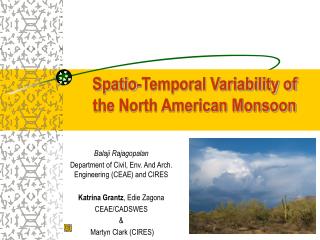
This study examines the seasonal patterns of cold cloud frequency (thunderstorms) associated with the North American Monsoon. Cold clouds predominantly appear in June over the central U.S. and Sierra Madre mountains. By August, these thunderstorms extend into Mexico and southern Arizona. The model explores how a Gulf Surge transports moisture from the Gulf of California to the American Southwest, facilitated by a thermal low over Arizona and southern California. It highlights the impact of easterly waves and convection on weather patterns during the monsoon.

E N D
North American Monsoon ATS 553
Cold Cloud Frequency In June: Cold clouds (i.e., thunderstorms) occur in the central U.S. and along the cordillera of the Sierra Madre mountains.
Cold Cloud Frequency In August: Cold clouds (i.e., thunderstorms) spread throughout Mexico and extreme southern Arizona.
Model of a Gulf Surge Transports moisture up the Gulf of California, up the Colorado River valley, and into the American Southwest.
Model of a Gulf Surge A Thermal Low exists over the deserts of Arizona and southern California.
Model of a Gulf Surge To get a Gulf Surge, you need to create an area of High pressure near the southern tip of Baja California. H
Model of a Gulf Surge Low level easterly waves slide across Central America, bringing convection.
Model of a Gulf Surge • When the convection is across the mouth of the Gulf of California, a region of relatively high pressure is created DUE TO COOLING. • Evaporation of raindrops • Reduced solar heating H
Model of a Gulf Surge At Yuma, Arizona: Winds shift out of the south-southeast. Temperatures FALL. Dewpoints RISE. H
Diurnal Cycle High altitudes have a peak of convection in mid afternoon. Low altitudes have a peak at night.